Tutorials
The viewer draws an alignment, a tree and whatever annotations you give it. Producing those files takes the work, in command-line tools outside the browser. Each walkthrough below is one continuous line of that work, where every step consumes what the step before produced, and ends on a URL that opens the result in JBrowseMSA. The last card is not a walkthrough: it collects the sessions that open an alignment inside JBrowse 2, beside a genome view and a structure. The picture on each card is a figure from the page it opens.
-
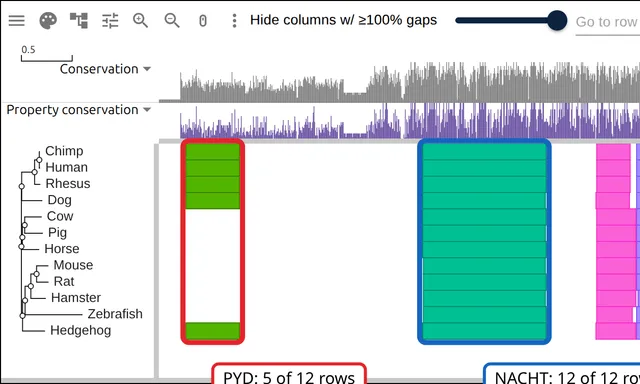 A protein family from a list of accessions
Twelve UniProt accessions to an alignment, a tree and Pfam domains, in four commands outside the viewer. Every step has a figure, and the last one is a link that shows which lineages lost a domain.
-
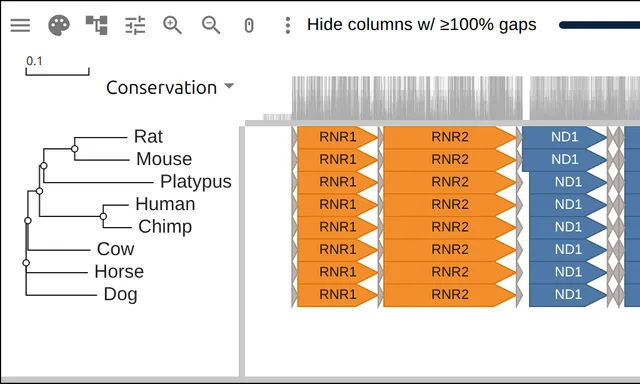 Eight mitochondrial genomes and the genes on them
Eight mammal mitogenomes from RefSeq as one alignment, with all 37 genes per genome drawn as strand arrows colored by respiratory complex. COX1 starts at a different base in every genome and in one column of the alignment; the control region ends in eight different columns.
-
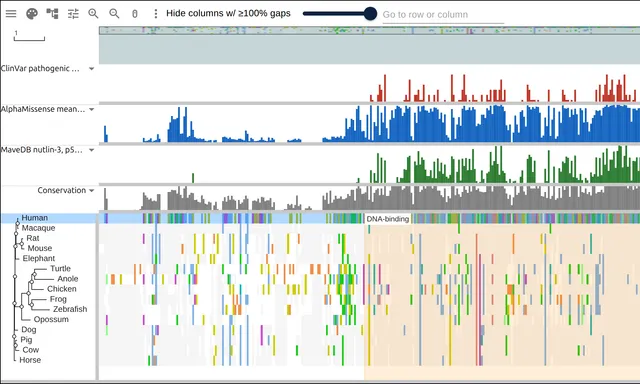 Where p53's damaging variants fall
ClinVar, AlphaMissense and a saturation screen, each a bar per residue over the same fifteen-species p53 alignment. The three sources share no data and draw over the same columns.
-
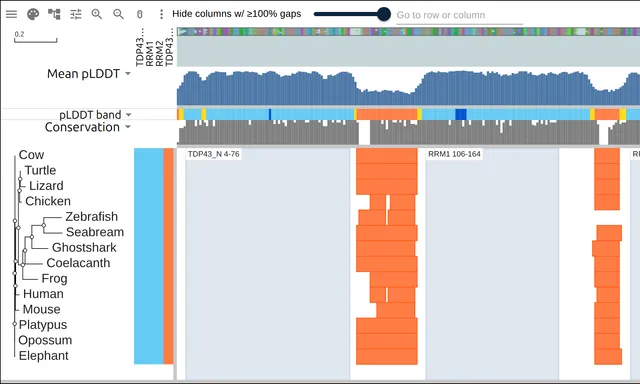 AlphaFold confidence across a protein family
Fourteen vertebrate TDP-43 orthologs, each with the per-residue pLDDT of its own AlphaFold model. The mean per column runs 84 to 86 over the three Pfam folded domains and 38 over the C-terminal region, and the runs under 50 fill that region in all fourteen rows.
-
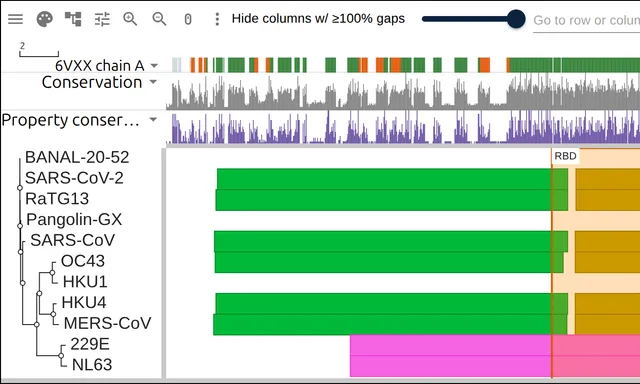 The SARS-CoV-2 furin insert and PDB 6VXX
Eleven coronavirus spikes, the four residues only SARS-CoV-2 carries, and a SIFTS correspondence recording which residues of that row PDB 6VXX resolved.
-
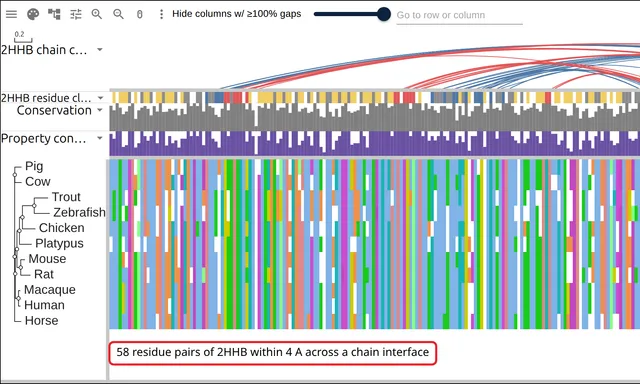 Hemoglobin's two subunits and the interfaces between them
Alpha and beta globin from eleven vertebrates, aligned per subunit and concatenated per species, with the 58 residue pairs in contact between the chains of PDB 2HHB drawn as arcs from one block to the other. The sliding alpha1beta2 interface is identical in 20 of its 28 residues from human to trout; the exposed surface is the least conserved class.
-
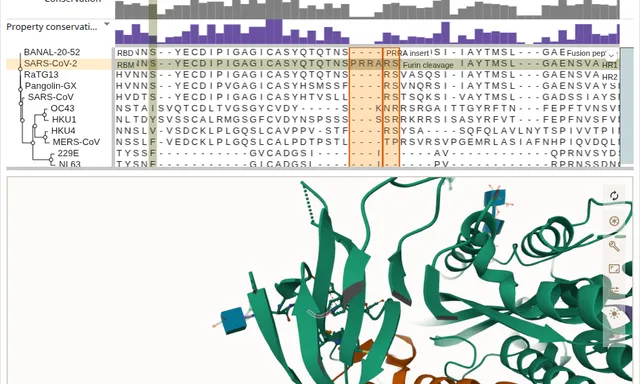 An alignment linked to its structure
The spike and hemoglobin alignments beside PDB 6VXX and 2HHB in Mol*, joined by the residueMappings layers the two tutorials above build. A residue hovered in either view lights in the other; the PRRA insert reports no coordinates, and a chain no mapping names reports no row. A checkbox colors each mapped chain by the conservation of its columns.
-
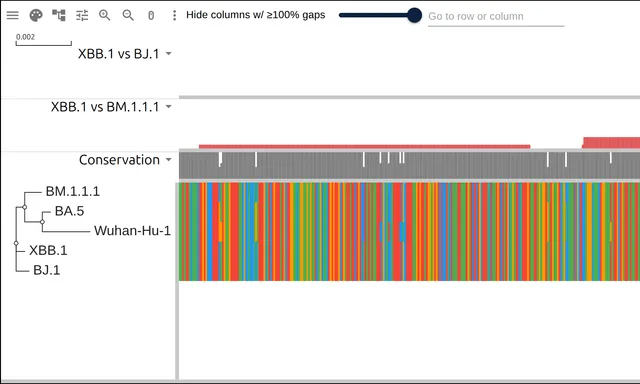 The recombination breakpoint in XBB's spike gene
Five whole SARS-CoV-2 genomes aligned with ClustalW, with the XBB.1 row scanned against each of the two BA.2 descendants it recombines. The two difference counts change places once inside the receptor-binding domain, and 41 of the 44 informative sites put the break between positions 22,896 and 22,942. A BA.5 control run through the same scan crosses nowhere.
-
 Recombination at the norovirus ORF1/ORF2 junction
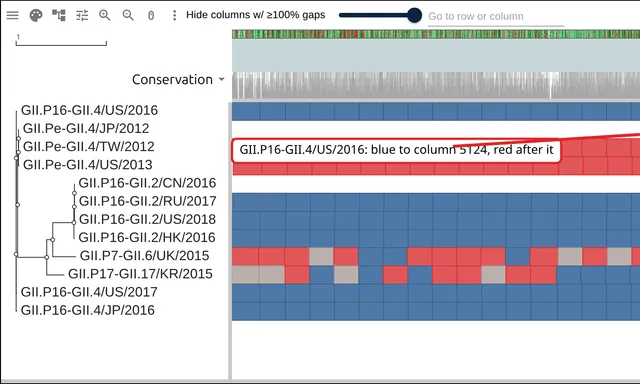
Twelve norovirus GII genomes aligned whole, with a tree from the ORF1 columns and another from the ORF2 columns. The three GII.P16-GII.4 rows read one parent for 25 windows and the other for 13, and the two identity curves change rank 14 columns before the first base of ORF2. A GII.Pe-GII.4 control never crosses.
-
 TEM beta-lactamase alleles and what they hydrolyze
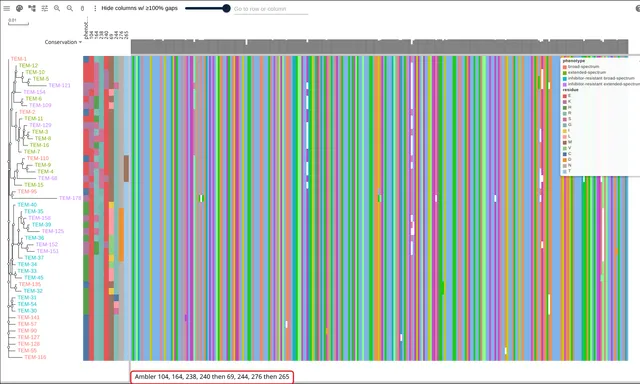
46 named TEM alleles from NCBI's Reference Gene Catalog, with the phenotype the catalog records and the residue each carries at the Ambler positions behind extended-spectrum and inhibitor resistance. All 22 extended-spectrum alleles are substituted at 104, 164, 238 or 240; a control position at 265 splits across three phenotypes.
-
 Reading cross-reactivity off the kinase pocket
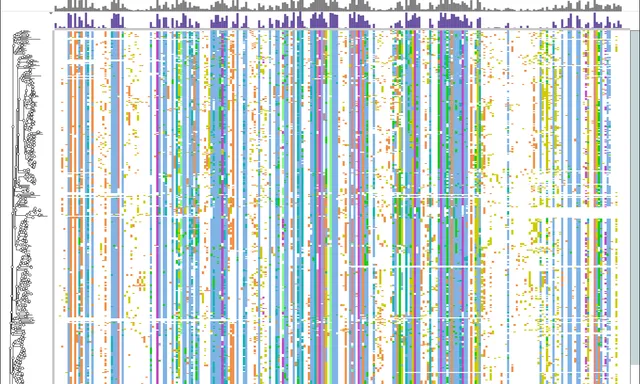
474 human kinase domains aligned with hmmalign, with a FastTree tree. The page compares the ATP-pocket residues of kinases imatinib inhibits with those it does not; the gatekeeper column reads threonine in 19% of them.
-
 An RNA family, from a model and six genomes
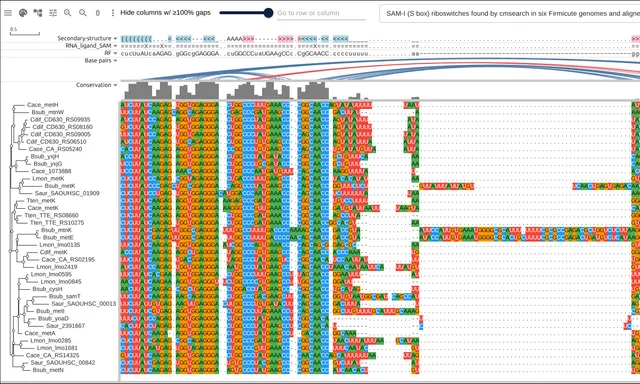
Search six bacterial genomes with an Rfam covariance model, align the 37 hits back to it, and read the consensus structure off the result: helix arcs, a pseudoknot, and the columns that hold still because the ligand touches them.
-
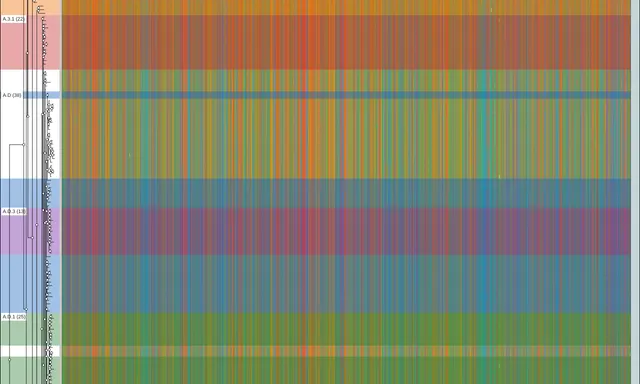 An RSV phylogeny from a public Nextstrain build
A Nextstrain tree of 1,840 RSV genomes, reconstructed to one whole-genome alignment and opened at every scale from the whole tree to a single variable column.
-
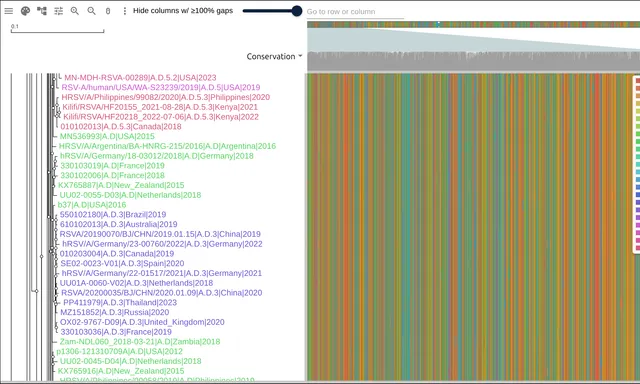 Coloring an RSV phylogeny by its metadata
The clade, country, region and year Nextstrain records for each of 184 RSV genomes, written as a row table and read by the viewer's tip-label, branch and row-tint channels. Clade colors 109 of the 179 internal edges; country colors 23.
-
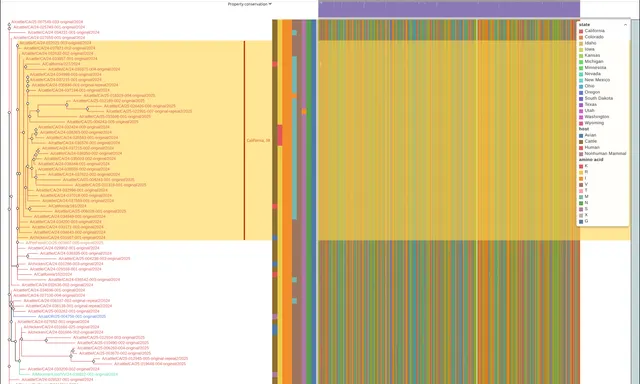 An H5N1 surveillance figure
204 genomes from Nextstrain's H5N1 cattle-outbreak build, with the host, the collecting state and one amino-acid site per segment as nine strips beside the HA alignment. NP 119 cuts the tree into 15 clades; host cuts it into 112.
-
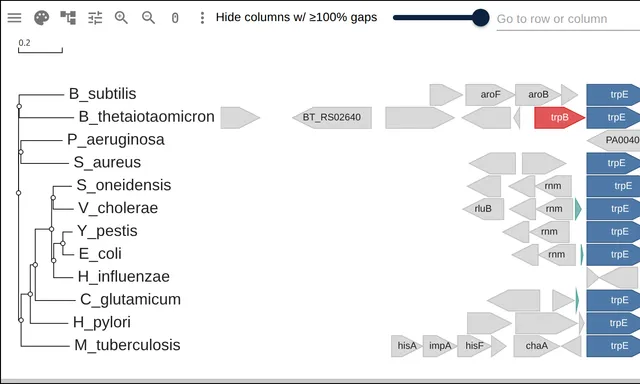 Gene neighborhoods of the tryptophan operon
Twelve bacterial genomes, 8 kb either side of trpB in each, drawn as a row of gene arrows in that genome's own coordinates beside a tree built from TrpB. An align transform on trpE brings ten of the twelve rows onto one origin; the two carrying no trpE stay where they were.
-
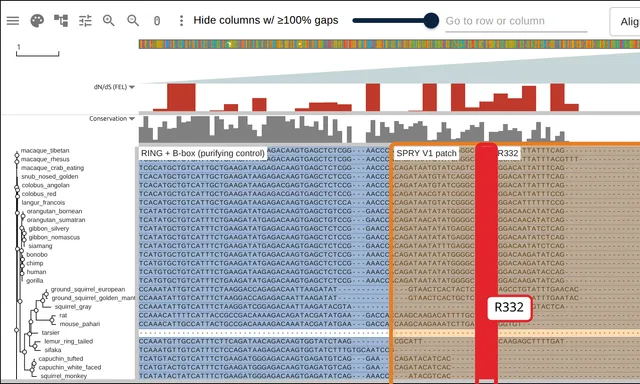 TRIM5 and the primate antiviral arms race
32 TRIM5 orthologs to a codon alignment, a tree, an exon structure and a per-codon dN/dS track from HyPhy. Ends on a link where the variable patch behind HIV-1 restriction has high dN/dS and a zinc-finger control has low dN/dS.
-
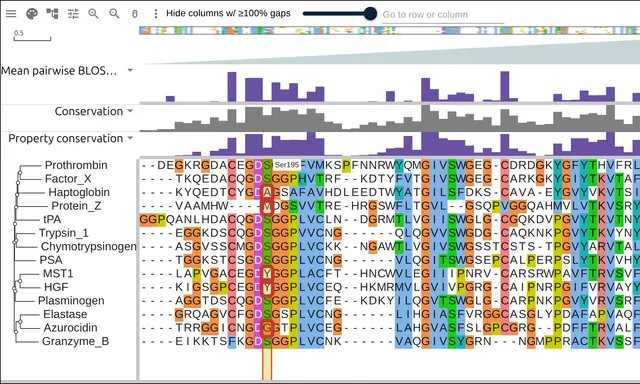 A protease family in R
Fourteen peptidase S1 domains cut from UniProt entries with Biostrings, aligned with DECIPHER, a tree from ape, and two layers R computes. Nine rows read the catalytic H, D and S; five read something else.
-
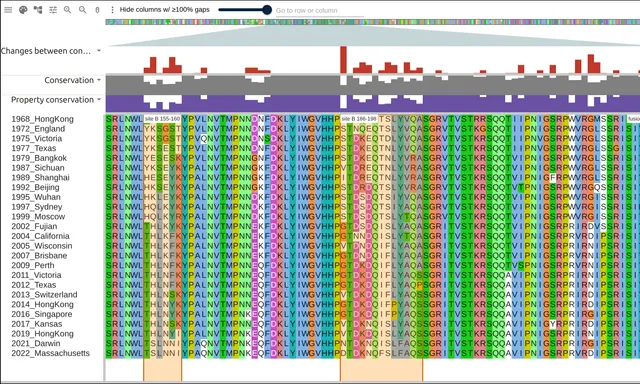 Influenza drift in a notebook
25 H3N2 vaccine strains from 1968 to 2022 as one hemagglutinin alignment in Jupyter, with a per-column count of how often each column changed. Antigenic site B reads 24 different strings; the fusion peptide reads two.
-
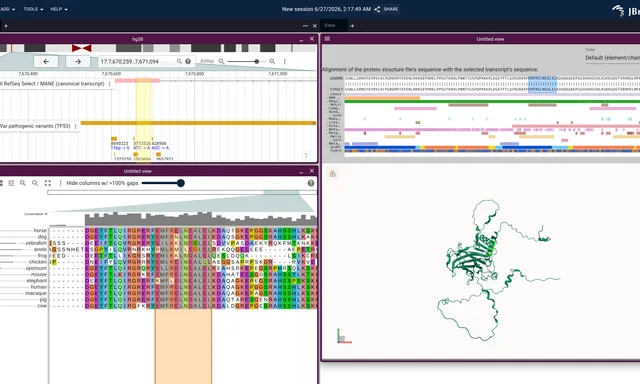 JBrowse 2 integration
The same alignment and tree opened inside JBrowse 2, beside a genome view and an AlphaFold structure. Selecting a region in one view highlights the matching columns, codons and residues in the others, and each session is a single URL.
The layers reference describes how values you computed (per-column values, labeled highlights, pairs of positions, a structure correspondence) load into the viewer as snapshot data, and the examples page runs the viewer live, one page per usage pattern, with the source of each.