TRIM5 and the primate antiviral arms race
TRIM5 is a restriction factor: a protein that recognizes an incoming retrovirus capsid and destroys it before the virus can establish an infection. Every primate lineage carries a copy, and the copies restrict different viruses. Human TRIM5 barely restricts HIV-1, and rhesus macaque TRIM5 restricts it strongly. A single substitution (R332P) converts the human protein into an HIV-1 restrictor (Stremlau et al. 2005; Yap et al. 2005). R332 sits in a patch of the protein that has been under positive selection across the primates for tens of millions of years (Sawyer et al. 2005): as viral capsids change, the restriction factor’s binding surface changes with them, and a codon alignment records that as an excess of amino-acid-changing substitutions over silent ones.
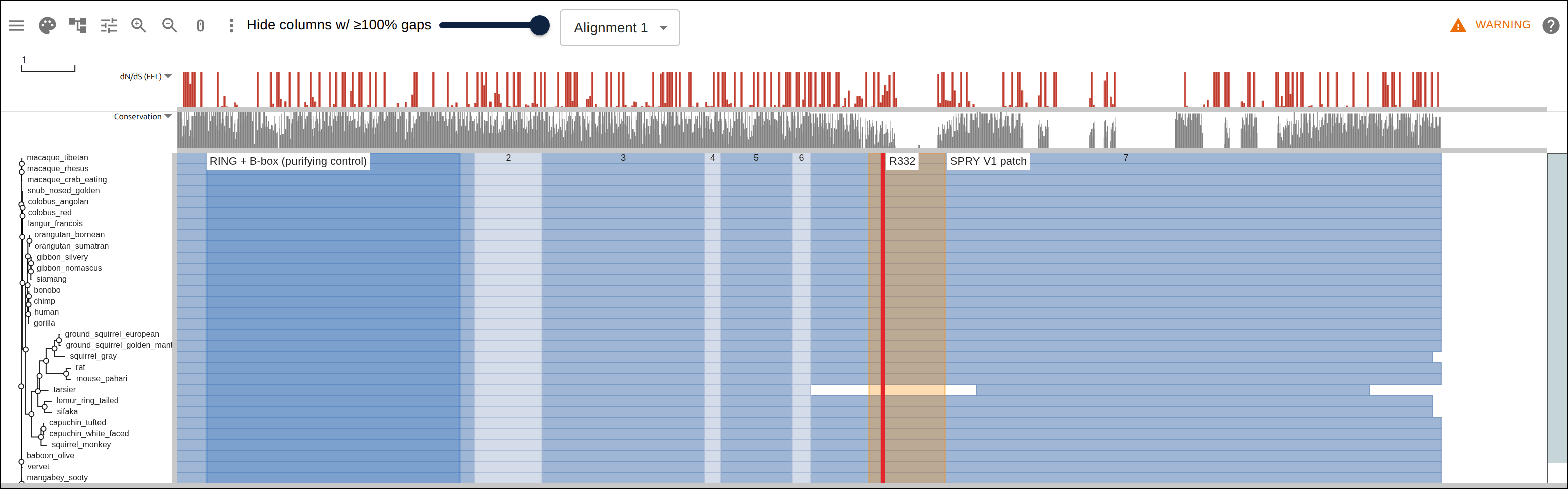
This page builds that alignment for 32 TRIM5 orthologs, infers a tree, adds the 7-exon gene structure and a per-codon dN/dS track from HyPhy, and ends on a link that opens all of it together: the alignment, the tree, the exons, the selection track and labels on the variable patch, on the single residue R332, and on the RING/B-box zinc fingers, a built-in control that the same analysis should call conserved.
Prerequisites#
curl,python3docker, for MACSE, FastTree and HyPhy (each pulled from biocontainers on first run)- NCBI Datasets command line tools
- react-msaview-cli,
npm install -g react-msaview-cli, NodeJS v22+
Where the data comes from#
- TRIM5 orthologs for human Gene ID 85363, fetched with the NCBI Datasets CLI over the Datasets v2 API: https://api.ncbi.nlm.nih.gov/datasets/v2/gene/id/85363/download
- Domain boundaries on the canonical human TRIM5 protein (UniProtKB Q9C035), read from InterPro’s precomputed matches: the RING and B-box zinc fingers from Pfam, https://www.ebi.ac.uk/interpro/api/entry/pfam/protein/uniprot/Q9C035/, and the full B30.2/SPRY domain from the wider PROSITE profile call, https://www.ebi.ac.uk/interpro/api/entry/profile/protein/uniprot/Q9C035/ (Pfam’s own SPRY entry stops short of the domain’s N-terminal variable loops)
- the codon alignment the commands below write, hosted so the figures can link to it: https://gmod.org/JBrowseMSA/demo/data/trim5/trim5-cds.stock
- its exon structure: https://gmod.org/JBrowseMSA/demo/data/trim5/trim5-exons.gff
1. Every ortholog NCBI knows about#
datasets download gene gene-id 85363 --ortholog all \
  --include gene,cds,protein --filename trim5_orthologs.zip
unzip -o trim5_orthologs.zip -d ortho
The download holds 33 records: 28 primates and, as the outgroup, 5
rodents/squirrels (mouse relative Mus pahari, rat, and three ground
squirrels). cds.fna in the package carries every predicted transcript for
every gene; human alone has 21.
2. One coding sequence per species#
Pick the curated (NM_) RefSeq transcript where the species has one; where
every transcript is a predicted (XM_) gene model, pick whichever is closest in
length to the well-annotated human isoform (1482 nt, 493 amino acids plus the
stop codon). A gene with dozens of predicted splice variants offers no better
criterion for choosing one transcript to align:
nm = [t for t in transcripts if t.accession.startswith('NM_')]
pool = nm if nm else transcripts
chosen = min(pool, key=lambda t: abs(len(t.seq) - 1482))
All 33 chosen sequences have a length that is a multiple of 3. Translating each
and scanning for a stop codon before the last one finds one problem: the black
snub-nosed monkey (Rhinopithecus bieti) has only one transcript on file,
XM_017887309.1, and it translates with two internal stops, at codons 260
and 265. The species has no other transcript, so the script drops it, and 32
orthologs go forward.
3. A codon-aware alignment#
docker run --rm -v "$PWD":/data -w /data \
  quay.io/biocontainers/macse:2.07--hdfd78af_0 \
  macse -prog alignSequences -seq trim5_cds.fasta \
  -out_NT trim5_macse_NT.fasta -out_AA trim5_macse_AA.fasta
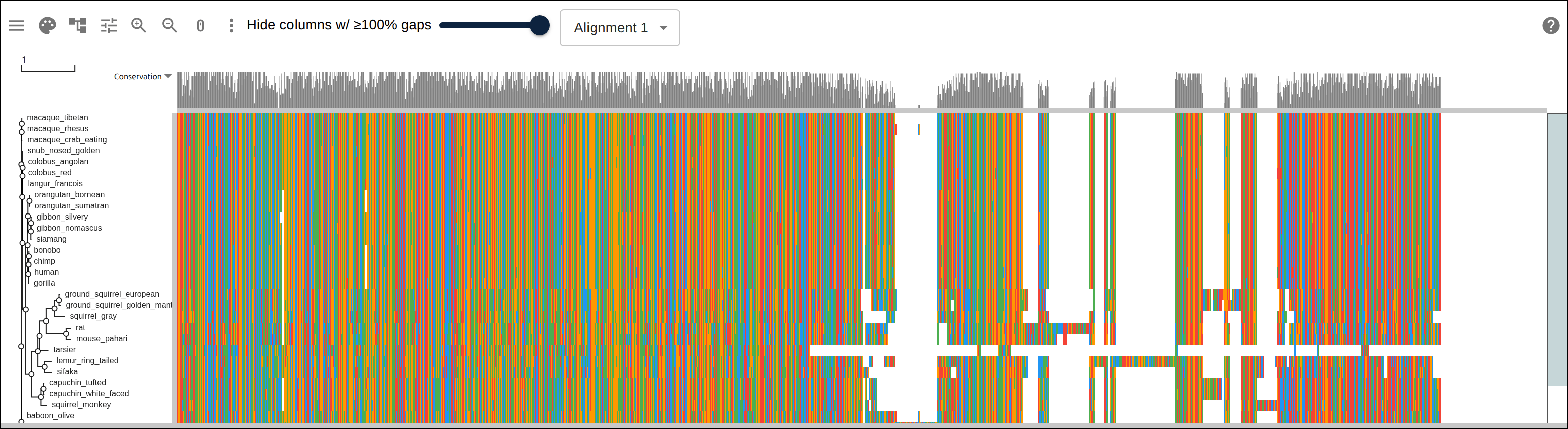
MACSE aligns in amino-acid space and writes back nucleotides, so every codon occupies three whole columns and the aligner introduces no frameshift. The result has 1800 nucleotide columns (600 codons) and takes a few minutes for 32 sequences.
Every sequence’s CDS includes its own stop codon, and the gaps put each one in a different alignment column. The script therefore checks and blanks each row’s last codon individually. All 32 rows carry exactly one stop codon, in the last position.
4. A tree#
docker run --rm -v "$PWD":/data -w /data \
  quay.io/biocontainers/fasttree:2.2.0--h7b50bb2_1 \
  sh -c "FastTree trim5_macse_AA.fasta > trim5.nwk"
FastTree runs on the protein translation, which carries more signal than the codons at this depth of divergence. Read the support values before relying on the topology (see also a protein family from a list of accessions). The weakest node in this tree has a local support of 0.135 and the second-weakest 0.177, both around the boundary between Old World monkey lineages, where a single gene’s tree is expected to be uncertain. The selection tests below depend on branch lengths, not on that part of the topology being right.
5. The exon structure#
genestructure projects TRIM5’s MANE Select transcript, NM_033034.3, from
the human reference row onto every row:
react-msaview-cli genestructure trim5_cds_aln.fasta \
  --gene-id 85363 --transcript NM_033034.3 --ref human \
  -o trim5-exons.gff
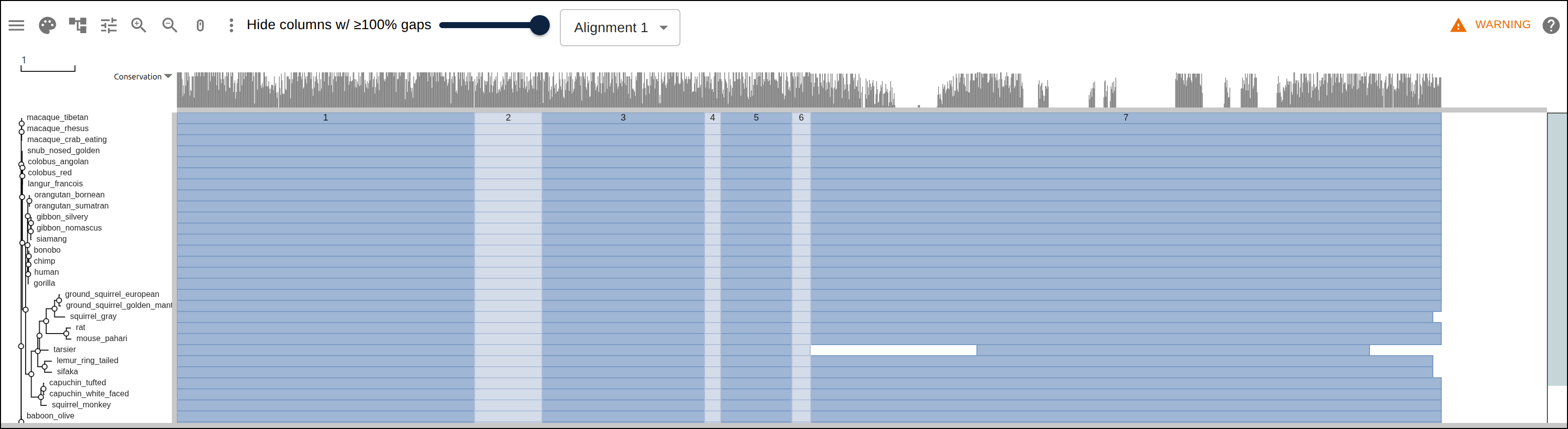
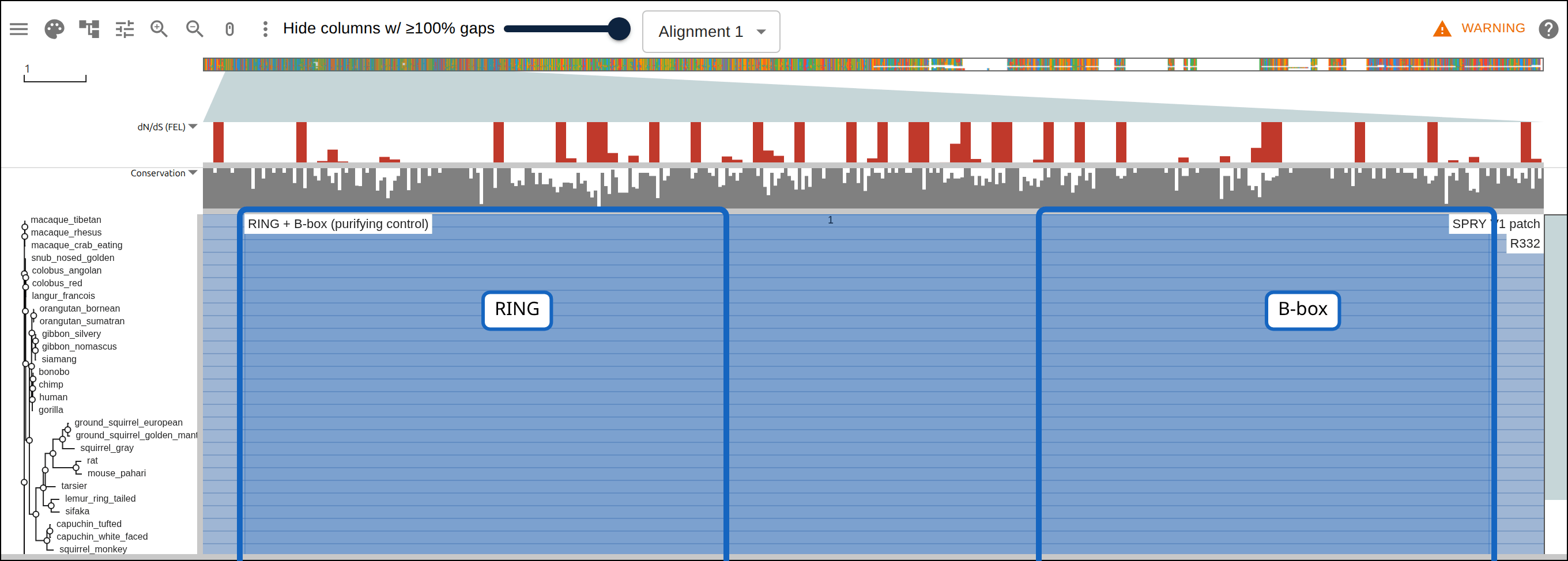
The transcript has 7 coding exons. Both zinc fingers this page uses as a control, RING and B-box, fall in the gene’s large first coding exon, and the variable patch in the SPRY domain falls in the last one.
6. Per-codon selection with HyPhy#
FEL (Fixed Effects Likelihood) fits a synonymous rate (alpha) and a non-synonymous rate (beta) at every codon and tests beta against alpha with a likelihood ratio:
docker run --rm -v "$PWD":/data -w /data \
  quay.io/biocontainers/hyphy:2.5.101--h526e2cb_0 \
  hyphy fel --alignment trim5_fel_input.fasta --tree trim5.nwk \
  --output trim5_fel.json --branches All
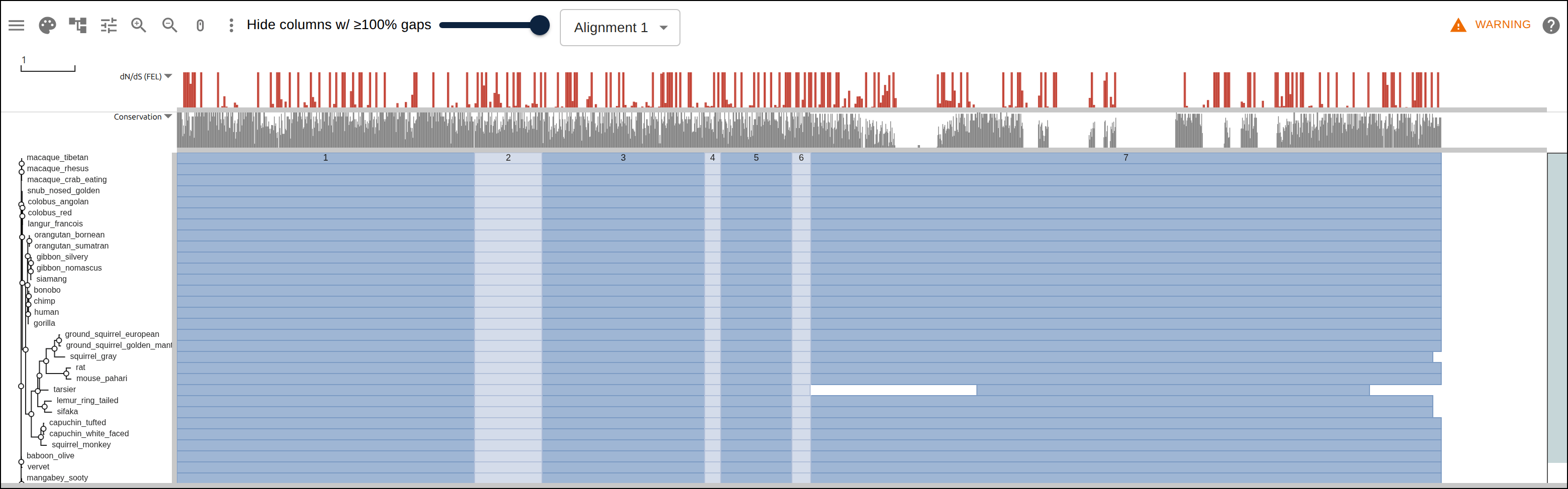
HyPhy’s single ratio across the whole tree and every codon is 0.82, so most of TRIM5 is under mild purifying selection. FEL’s per-site test (default p<0.1, 32 taxa, all 600 codon columns, about 3 minutes with no subsampling) calls 33 of 600 sites (5.5%) positively selected and 80 (13.3%) negatively selected. The strongest positively selected site in the gene is human residue 337 (alpha near zero, beta = 23.5, p = 0.0063), inside the variable patch that step 7 zooms into.
MEME tests the same alignment for episodic rather than pervasive selection, one branch at a time per site:
docker run --rm -v "$PWD":/data -w /data \
  quay.io/biocontainers/hyphy:2.5.101--h526e2cb_0 \
  hyphy meme --alignment trim5_fel_input.fasta --tree trim5.nwk \
  --output trim5_meme.json --branches All
27 of 600 sites (p<0.05) show episodic diversifying selection, and 18 of those 27 (two-thirds) fall inside the B30.2/SPRY domain. The second-strongest MEME hit in the whole gene (p = 0.0022) is again human residue 337, agreeing with FEL. The strongest hit (p = 0.0011) is human residue 45, one of the 45 codons of the RING domain, which this page uses as the purifying control.
The track draws the per-codon beta/alpha ratio. A site with almost no synonymous
substitutions puts alpha near zero, and the ratio grows without bound: at human
residue 371 the optimizer returns alpha = 5098. The script therefore clamps the
values to 5 and writes them as one nucleotide-column-wide JSON array
(packages/app/public/data/trim5/trim5-dnds-values.json), repeated three times
per codon and passed as a columnTracks bar (see
data layers):
7. The SPRY variable patch#
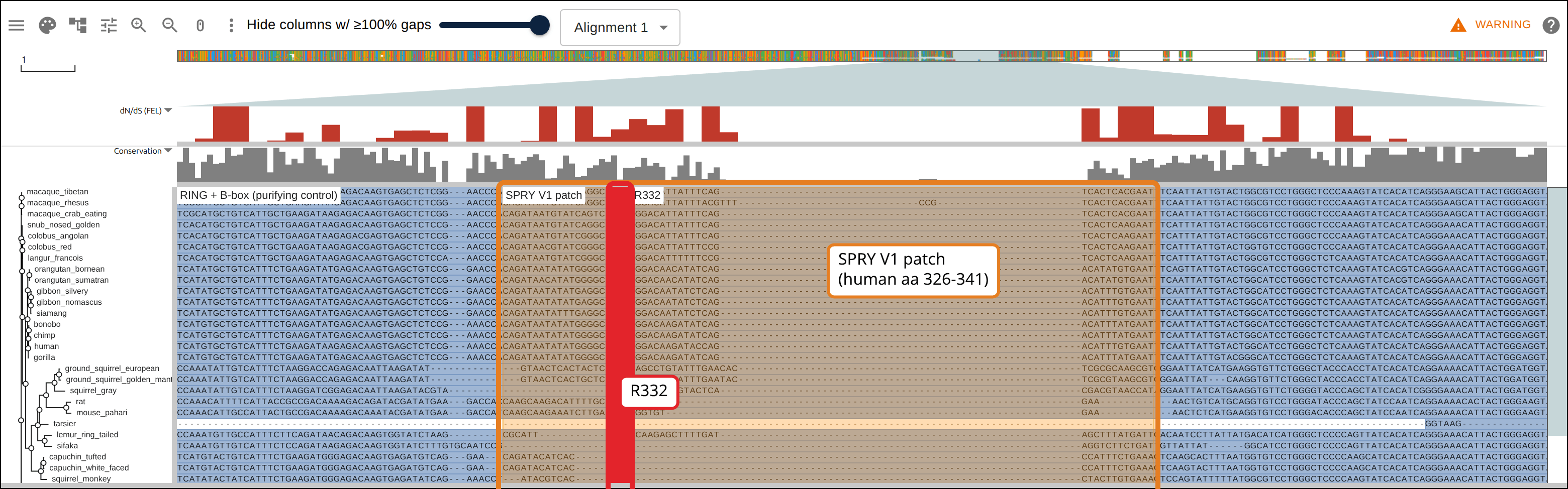
Sawyer et al. (2005) found a small patch of the SPRY domain carrying most of the gene’s positively selected sites, overlapping the “variable region 1” (V1) loop later work narrowed the HIV-1 restriction specificity down to (Stremlau et al. 2005; Yap et al. 2005; Ohkura et al. 2006), human residues 326-341. R332 sits in the middle of it, and R332P alone is the substitution that converts human TRIM5 into an HIV-1 restrictor:
"highlights": [
  { "row": "human", "start": 976, "end": 1023, "label": "SPRY V1 patch" },
  { "row": "human", "start": 994, "end": 996, "label": "R332" }
](start/end are the human row’s own nucleotide positions: residue 326 is
nucleotide 976, (326-1)*3+1, and R332 is nucleotides 994-996.)
8. The purifying control#
RING and B-box are the zinc-finger domains that fold the protein and drive its E3 ubiquitin ligase activity, so the same analysis should call them conserved. The figure above shows both as a combined highlight, and this figure zooms into them:
9. Open it#
This snapshot combines the last three figures: alignment, tree, exon structure, the dN/dS track and both highlights.
Reproduce it end to end#
curl -O https://raw.githubusercontent.com/GMOD/JBrowseMSA/main/docs/tutorials/scripts/build_codon_selection.sh
bash build_codon_selection.sh
With no arguments the script writes every file into the current directory. Point
it at another gene by editing the GENE_ID and the --transcript argument to
genestructure; the CDS-selection and stop-codon QC steps are generic.
See also#
References#
- Sawyer SL, Wu LI, Emerman M, Malik HS. Positive selection of primate TRIM5alpha identifies a critical species-specific retroviral restriction domain. Proceedings of the National Academy of Sciences 102:2832-2837 (2005).
- Stremlau M, Perron M, Welikala S, Sodroski J. Species-specific variation in the B30.2(SPRY) domain of TRIM5alpha determines the potency of human immunodeficiency virus restriction. Journal of Virology 79:3139-3145 (2005).
- Yap MW, Nisole S, Stoye JP. A single amino acid change in the SPRY domain of human Trim5alpha leads to HIV-1 restriction. Current Biology 15:73-78 (2005).
- Ohkura S, Yap MW, Sheldon T, Stoye JP. All three variable regions of the TRIM5alpha B30.2 domain can contribute to the specificity of retrovirus restriction. Journal of Virology 80:8554-8565 (2006).
- Ranwez V, Douzery EJP, Cambon C, Chantret N, Delsuc F. MACSE v2: toolkit for the alignment of coding sequences accounting for frameshifts and stop codons. Molecular Biology and Evolution 35:2582-2584 (2020).
- Price MN, Dehal PS, Arkin AP. FastTree 2: approximately maximum-likelihood trees for large alignments. PLOS ONE 5:e9490 (2010).
- Kosakovsky Pond SL, Frost SDW. Not so different after all: a comparison of methods for detecting amino acid sites under selection. Molecular Biology and Evolution 22:1208-1222 (2005).
- Murrell B, Wertheim JO, Moola S, Weighill T, Scheffler K, Kosakovsky Pond SL. Detecting individual sites subject to episodic diversifying selection. PLOS Genetics 8:e1002764 (2012).