A protein family from a list of accessions
Human NLRP1, an immune sensor, starts with about eighty residues, a pyrin domain, that the mouse protein lacks. Aligning the two with their relatives puts the shared domains in the same columns, and the pyrin domain’s absence shows as blank space in the rows without it. This page starts from twelve UniProt accessions for NLRP1 and ends on a link that opens the twelve sequences aligned, with the tree inferred from them and their Pfam domains drawn in the alignment’s coordinates. Four commands produce the three files.
Prerequisites#
curl- ClustalW,
apt install clustalwon Debian or Ubuntu,brew install clustal-won macOS. ClustalW both aligns and infers a tree, so this page needs no other aligner. - react-msaview-cli,
npm install -g react-msaview-cli, NodeJS v22+
Every figure below links to the live view it captured.
Where the data comes from#
Twelve NLRP1 orthologs as UniProtKB holds them, with Pfam matches from InterPro release 110.0.
- one protein sequence per accession: https://rest.uniprot.org/uniprotkb/Q9C000.fasta
- precomputed Pfam matches for that accession: https://www.ebi.ac.uk/interpro/api/entry/pfam/protein/uniprot/Q9C000/
- the twelve sequences before alignment, right-padded to one width so the viewer opens them: https://gmod.org/JBrowseMSA/demo/data/nlrp1-unaligned.aln
- the alignment the commands below write, hosted so the figures can link to it: https://gmod.org/JBrowseMSA/demo/data/nlrp1.aln
- its tree: https://gmod.org/JBrowseMSA/demo/data/nlrp1.nh
- its domains: https://gmod.org/JBrowseMSA/demo/data/nlrp1-domains.gff
Both endpoints serve one protein per request, so the whole family takes twelve requests to each.
The family#
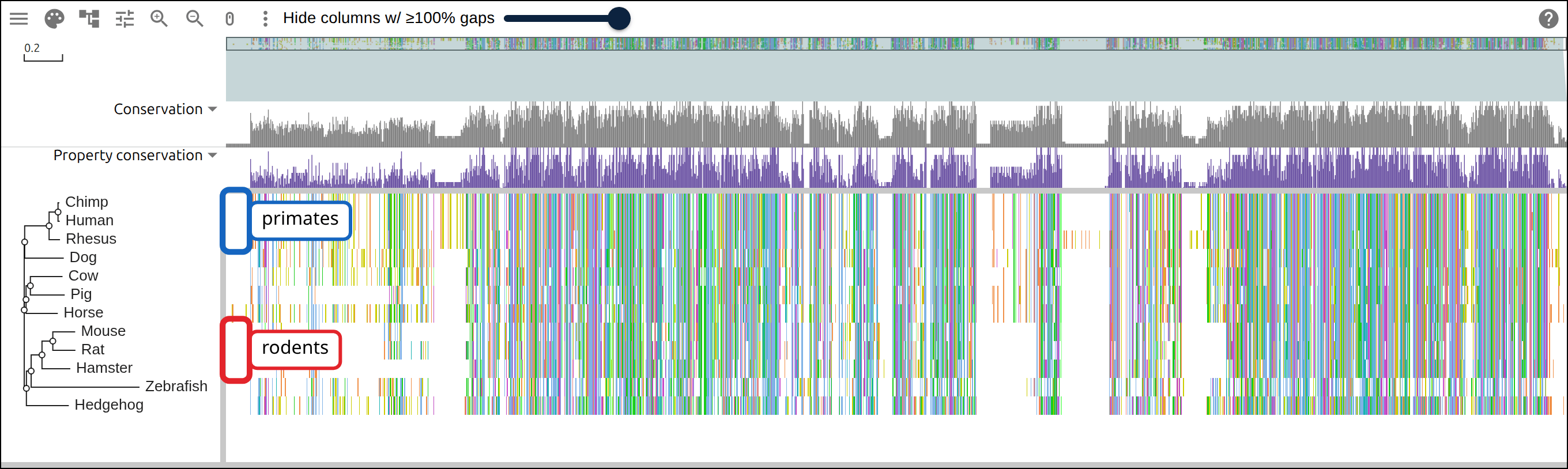
NLRP1 is an inflammasome sensor. Every vertebrate ortholog shares the same core in the same order: a NACHT nucleotide-binding domain, a winged helix, a helical domain, then FIIND and CARD at the C terminus. The orthologs differ at the N terminus, where primates carry a pyrin (PYD) death-fold domain and rodents do not.
The proteins run from 1143 to 1537 residues, so residue 328 is a different place in every row. Drawing the domains in each protein’s own coordinates puts the shared core in twelve different places; drawing them in the alignment’s coordinates puts it in one.
1. Name the rows#
Write one accession per line, followed by the label you want down the side of the viewer. The label becomes the FASTA defline, the tree tip, and the first column of the domain GFF.
Q9C000	Human
H2QC06	Chimp
A0A1D5QWR0	Rhesus
A0A8I3MJ75	Dog
A0ABM3YGI7	Hedgehog
E1BNN6	Cow
K9IW94	Pig
A0A9L0RFW2	Horse
Q2LKU9	Mouse
D9I2G4	Rat
A0ABM2XMM7	Hamster
A0A386CAB9	Zebrafish
Save that as accessions.tsv. The separator is a tab, and a line starting with
# is a comment, so the file can carry its own notes about why each row is in
it.
2. Fetch the sequences#
# read each accession and write one FASTA record named by its label, which is
# what the viewer draws down the side
while IFS=$'\t' read -r accession label; do
  printf '>%s\n' "$label" >> family.fasta
  curl -sf "https://rest.uniprot.org/uniprotkb/$accession.fasta" |
    tail -n +2 | tr -d '\n' >> family.fasta
  printf '\n' >> family.fasta
done < accessions.tsv
tail -n +2 drops UniProt’s own defline, which carries the accession, the
species and the protein name; tr -d '\n' unwraps the sequence onto one line.
Check what you got before aligning it:
awk '/^>/{name=$0; next}{print name, length($0)}' family.fasta>Human 1473
>Chimp 1471
>Rhesus 1537
>Dog 1432
>Hedgehog 1360
>Cow 1410
>Pig 1294
>Horse 1465
>Mouse 1182
>Rat 1218
>Hamster 1143
>Zebrafish 1355All twelve records have plausible lengths for a full-length NLRP1. A truncated fragment or a stray isoform would show up here as an outlier length.
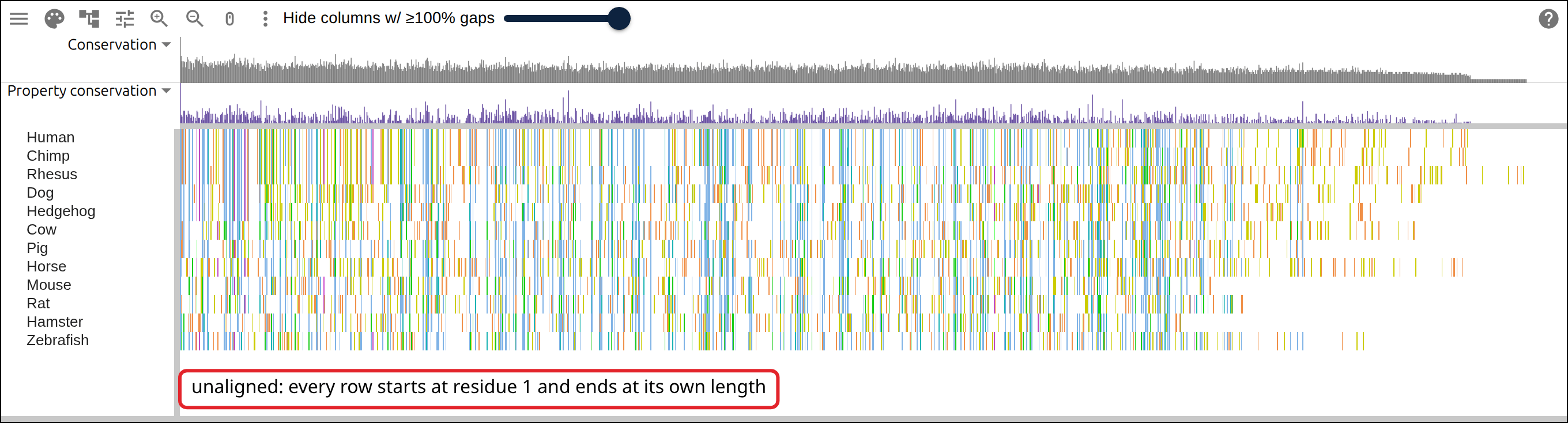
The viewer opens unaligned sequences as readily as an alignment, once every row
is the same length. Right-pad the shorter ones and family.fasta loads as a
block of twelve rows.
3. Align them#
clustalw -INFILE=family.fasta -ALIGN -TYPE=PROTEIN \
  -OUTPUT=FASTA -OUTFILE=family.afa
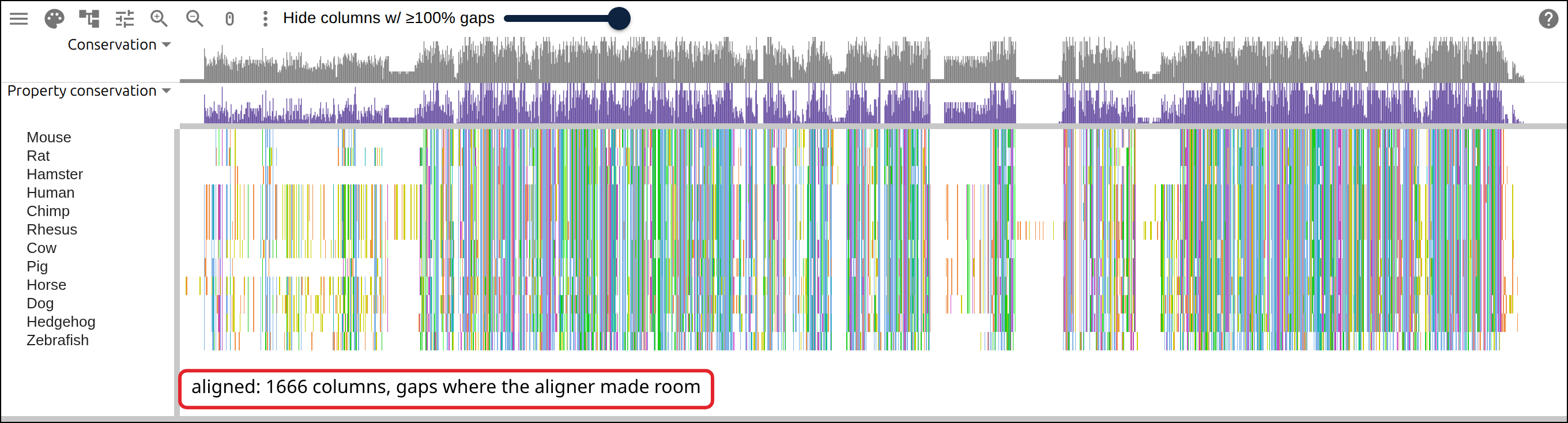
The alignment takes under two seconds. ClustalW reports Alignment Score 258590
and 1666 columns, 129 more than the longest input, to make room for insertions.
ClustalW is a progressive aligner. It is fast and deterministic, needs no configuration, and places the domain architecture below in the right columns. For a figure about the phylogeny, use MAFFT or MUSCLE for the alignment and IQ-TREE or RAxML for the tree.
4. Infer a tree#
# -TREE reads an existing alignment and writes neighbor-joining Newick
clustalw -INFILE=family.afa -TREE -TYPE=PROTEIN -OUTPUTTREE=phylip

# ClustalW wraps the Newick across many lines; the viewer wants one string
tr -d '[:space:]' < family.ph > family.nwk
Read the result before trusting it:
(((((Mouse:0.11672,Rat:0.11797):0.05644,Hamster:0.14779):0.05664,
Zebrafish:0.56540):0.02478,Hedgehog:0.22128):0.01141,...
Zebrafish sits inside the rodents. It should be the outgroup, and its branch length is 0.56540 against 0.11 to 0.22 for everything else, the longest branch in the tree by a factor of three. Neighbor joining pulls the longest branch towards whichever other branch is longest (long-branch attraction). This page uses the tree to order the rows; its topology is not a phylogenetic result.
With the tree open beside the alignment, the viewer draws the rows in tree order.
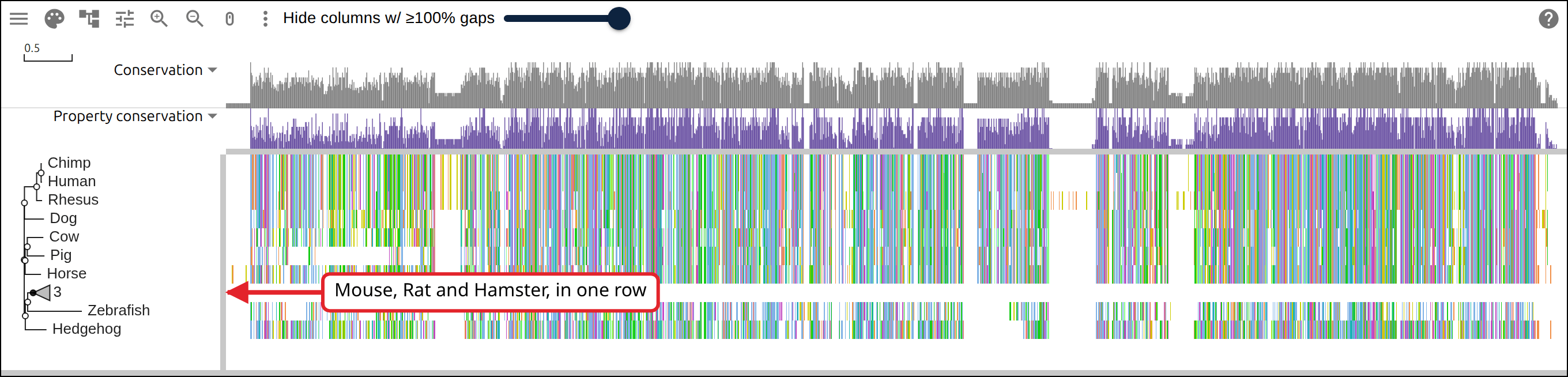
Clicking a node in the tree collapses the clade under it into one triangle, labelled with how many tips it holds, and hides those rows from the alignment.
5. Ask InterPro what the domains are#
InterPro precomputes matches for every UniProtKB sequence, so for accessions the CLI looks them up:
react-msaview-cli interpro accessions.tsv -o family-domains.gffInterPro release 110.0; reading precomputed pfam matches...
[1/12] Q9C000: 9 pfam entries
...
12 fetched, 0 from /home/you/.cache/react-msaview-cli/interproThe lookup takes four seconds for twelve proteins. The CLI writes the release number into the GFF header, which pins the coordinates in the figures to one InterPro version. A rerun reads from the disk cache and makes a single request.
The other command, react-msaview-cli interproscan, submits sequences to the
EBI job queue and waits about fifteen minutes. Use it for de novo assemblies or
predicted proteins that InterPro has never seen.
Count what came back before drawing it:
grep IPR004020 family-domains.gff | cut -f1Human
Chimp
Rhesus
Dog
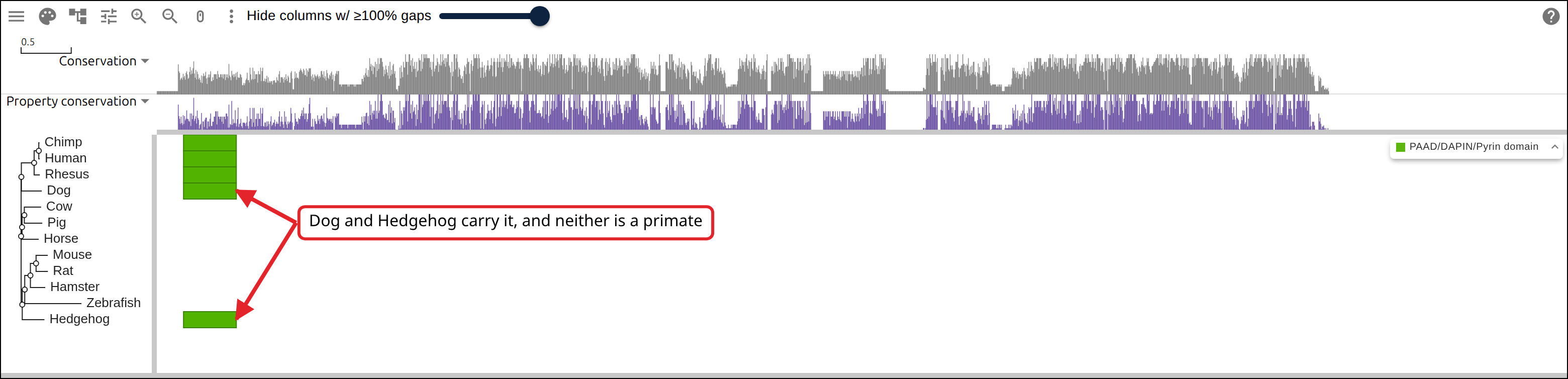
HedgehogFive rows out of twelve carry the PYD, at residues 9-83 in each.
6. Open the three files#
family.afa, family.nwk and family-domains.gff go in the alignment, tree
and annotation slots of the import form,
either as local files or as URLs. Each slot has a FILE and a URL toggle, and the
GFF slot is the one marked optional.
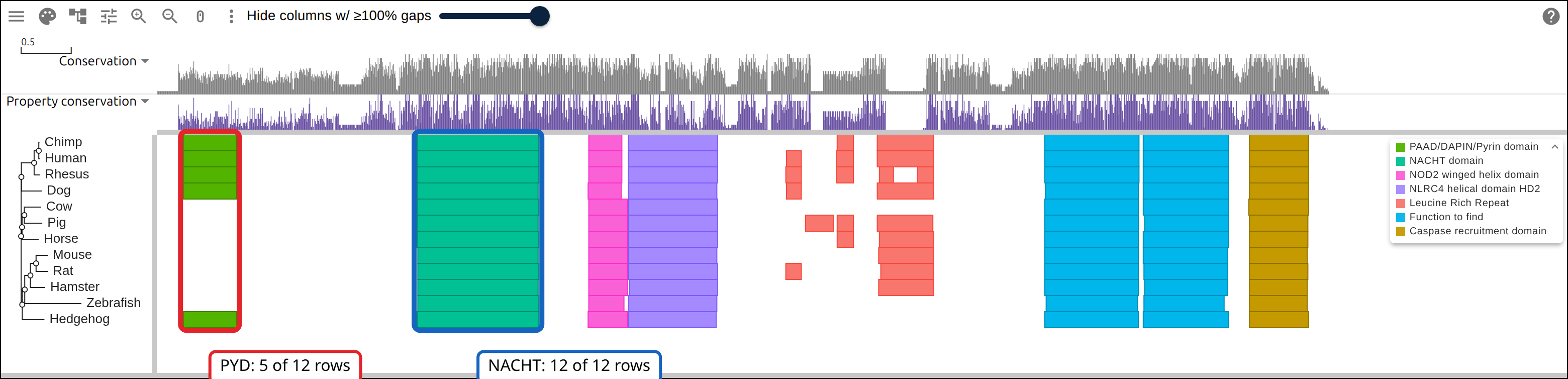
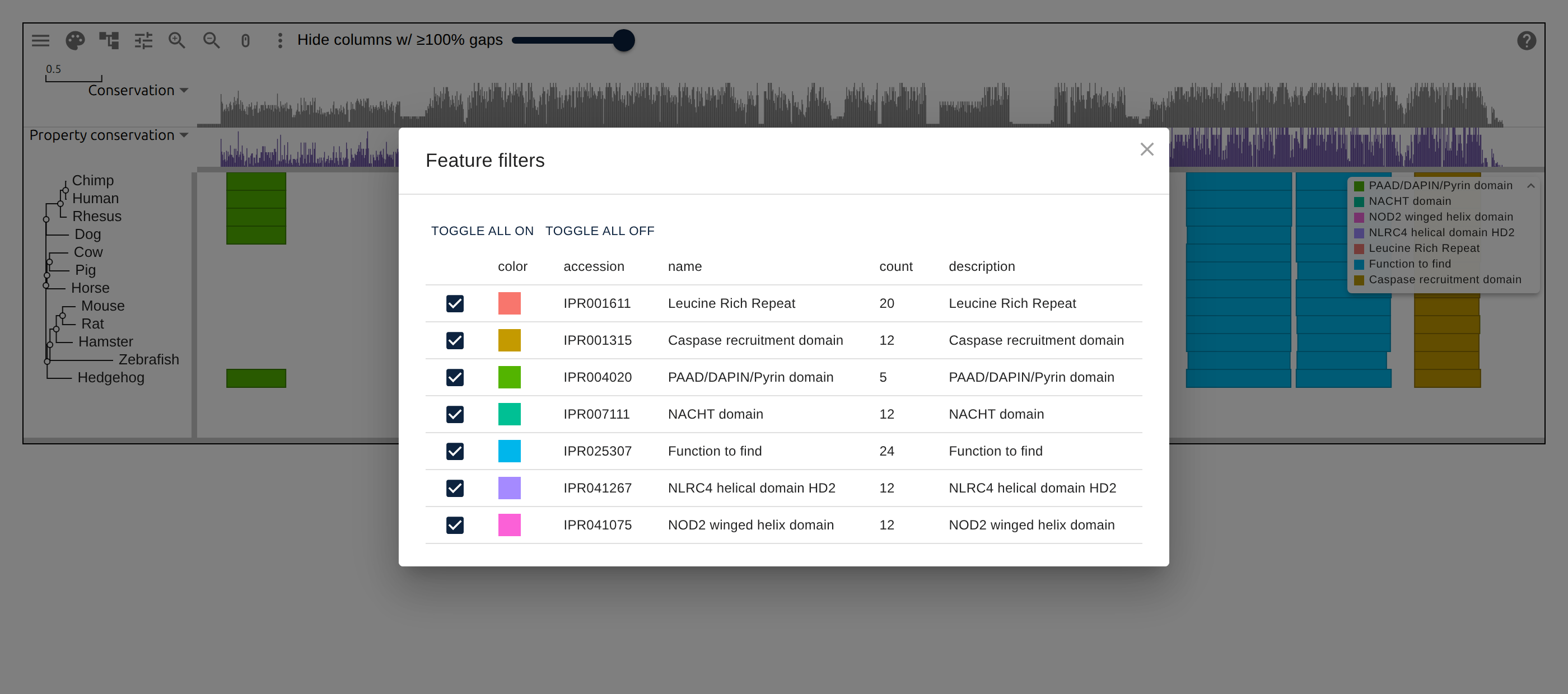
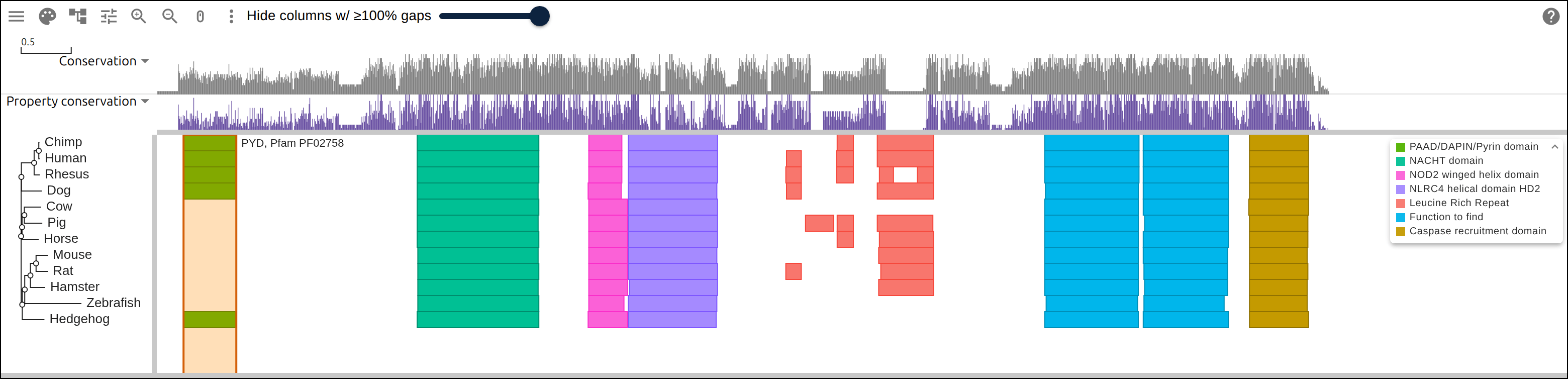
The legend in the top right names every accession in the file, and File → Annotations → Filter annotations opens the same list with a checkbox and a count per accession.
Rows with the pyrin domain#
Unchecking everything except IPR004020 leaves only the pyrin domain on screen.
Domain coordinates and columns#
The NACHT domain is annotated in all twelve rows, and InterPro reports it at a different residue in each:
grep IPR007111 family-domains.gff | cut -f1,4,5Human 328 497
Chimp 328 497
Rhesus 332 501
Dog 299 467
Hedgehog 296 465
Cow 294 463
Pig 162 330
Horse 328 493
Mouse 134 301
Rat 176 344
Hamster 93 258
Zebrafish 258 428Human 328 and Hamster 93 are 235 residues apart. In the viewer, Human, Chimp, Rhesus, Dog, Hedgehog, Cow, Pig and Horse all begin that domain in column 371, and Mouse, Rat, Hamster and Zebrafish begin it in column 372, because the overlay projects each row’s residue coordinates through that row’s own gaps before drawing. The same projection draws the PYD in one place in the five rows that carry it, and the seven rows without it are empty there.
Missing annotations#
Cow, Hedgehog and Zebrafish have no leucine-rich repeats called at all, where Human has three and Rhesus four:
grep IPR001611 family-domains.gff | cut -f1 | sort | uniq -c 2 Chimp
2 Dog
1 Hamster
2 Horse
3 Human
1 Mouse
3 Pig
2 Rat
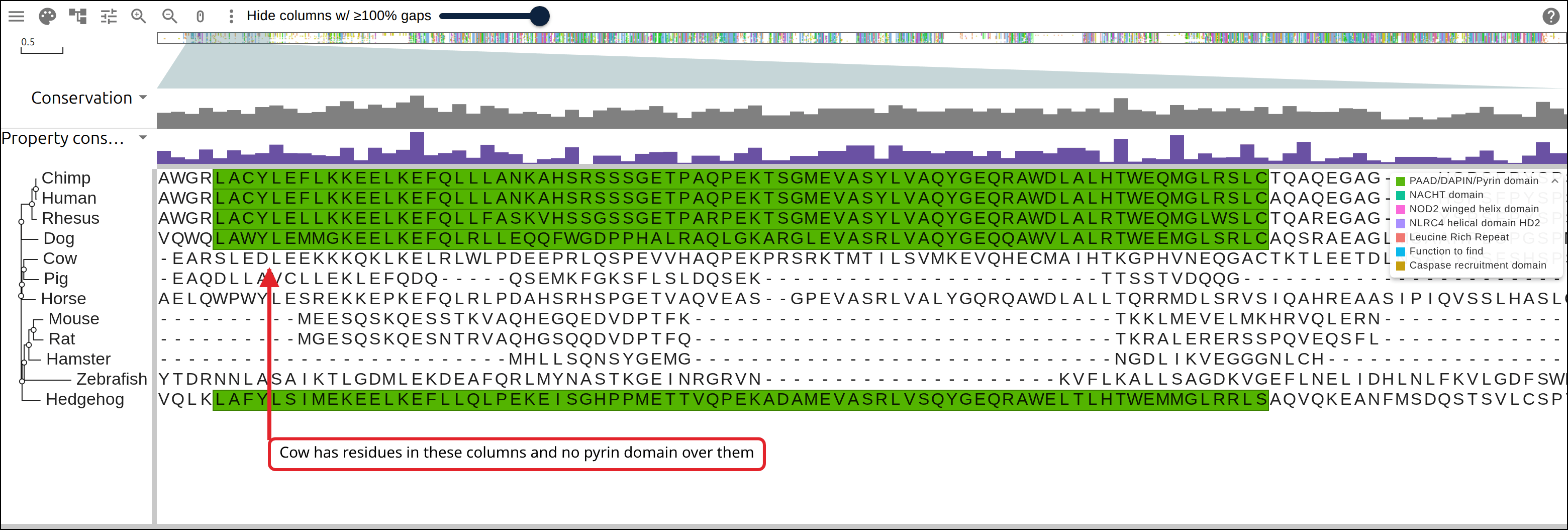
4 RhesusA region that draws blank can mean the protein has none, or that nobody annotated the ones it has. Several of these rows are unreviewed entries whose gene models under-call. At whole-protein scale the two look identical; at base resolution a row with residues under an unannotated stretch looks different from a row that is gap there.
Share the view#
A file you opened from your own computer travels inside the page URL, and an
alignment this size does not fit, so the header says Not in the link. Put
the three files on a server that sends them over HTTPS with CORS (a GitHub repo
through raw.githubusercontent.com works), and name the URLs instead:
{
  "msaview": {
    "type": "MsaView",
    "colWidth": 0.7,
    "colorSchemeName": "clustalx_protein_dynamic",
    "msaFilehandle": { "uri": "https://example.org/family.afa" },
    "treeFilehandle": { "uri": "https://example.org/family.nwk" },
    "gffFilehandle": { "uri": "https://example.org/family-domains.gff" },
    "highlights": [{ "start": 39, "end": 113, "label": "PYD, Pfam PF02758" }]
  }
}
URL-encode that and append it to the app as #data=. The link carries the
addresses of the files, so it works at any size. The optional highlights takes
1-based inclusive columns and puts the PYD band in the link.
Reproduce it end to end#
curl -O https://raw.githubusercontent.com/GMOD/JBrowseMSA/main/docs/tutorials/scripts/build_protein_family.sh
bash build_protein_family.sh
With no arguments the script writes the accession list above and builds all three files beside it. Point it at your own list to do the same for another family:
bash build_protein_family.sh my-accessions.tsv out/See also#
References#
- Bateman A, et al. UniProt: the Universal Protein Knowledgebase in 2025. Nucleic Acids Research 53:D609-D617.
- Blum M, et al. InterPro: the protein sequence classification resource in 2025. Nucleic Acids Research 53:D444-D456.
- Larkin MA, et al. Clustal W and Clustal X version 2.0. Bioinformatics 23:2947-2948.
- Broz P, Dixit VM. Inflammasomes: mechanism of assembly, regulation and signalling. Nature Reviews Immunology 16:407-420.