Recombination at the norovirus ORF1/ORF2 junction
Norovirus GII carries two genotype names, one for its polymerase and one for its capsid, so a GII.P16-GII.4 Sydney genome has the polymerase of GII.P16 and the capsid of GII.4 Sydney. The two halves meet at the ORF1/ORF2 junction, where the nonstructural polyprotein ends and VP1 begins. This page takes twelve complete GII genomes, aligns them whole, builds one tree from the ORF1 columns and another from the ORF2 columns, and reads the join off the column where a GII.P16-GII.4 row stops matching one parent and starts matching the other. GII.Pe-GII.4/US/2013 is the control: a row of the capsid donor’s own genotype, which reads the same parent on both sides of the junction.
Prerequisites#
curl- Docker, which the script uses to run MAFFT 7.525 and FastTree 2.2.0 from their biocontainers images. Nothing else is installed.
- Python 3, standard library only
Every figure below links to the live view it captured.
Where the data comes from#
Twelve norovirus GII genomes as GenBank holds them, sequence and annotation both.
- all twelve genomes, one request: https://eutils.ncbi.nlm.nih.gov/entrez/eutils/efetch.fcgi?db=nuccore&id=MK773584.1,MK762638.1,LC175468.1,NC_039476.1,KY771081.1,MK752935.1,MG892974.3,KJ196281.1,KJ196296.1,KY486271.1,NC_040876.1,NC_039475.1&rettype=fasta&retmode=text
- the same twelve as GenBank flatfiles, which carry the CDS spans: https://eutils.ncbi.nlm.nih.gov/entrez/eutils/efetch.fcgi?db=nuccore&id=MK773584.1,MK762638.1,LC175468.1,NC_039476.1,KY771081.1,MK752935.1,MG892974.3,KJ196281.1,KJ196296.1,KY486271.1,NC_040876.1,NC_039475.1&rettype=gb&retmode=text
- the row table the commands below start from, hosted so the figures can link to it: https://gmod.org/JBrowseMSA/demo/data/norovirus/noro-rows.tsv
- the alignment they write: https://gmod.org/JBrowseMSA/demo/data/norovirus/noro.afa
- the tree from the ORF1 columns: https://gmod.org/JBrowseMSA/demo/data/norovirus/noro-orf1.nwk
- the tree from the ORF2 columns: https://gmod.org/JBrowseMSA/demo/data/norovirus/noro-orf2.nwk
- the three ORFs of every genome: https://gmod.org/JBrowseMSA/demo/data/norovirus/noro-orfs.gff
- each row’s closer parent in 200-base windows: https://gmod.org/JBrowseMSA/demo/data/norovirus/noro-parents.gff
- the 600 columns either side of the junction: https://gmod.org/JBrowseMSA/demo/data/norovirus/noro-junction.afa
- the identity tracks, the layers the links below carry: https://gmod.org/JBrowseMSA/demo/data/norovirus/noro-layers.json
1. Name the rows#
Write one genome per line: the label the viewer draws, the GenBank accession, and the genotype the record’s own isolate name or note carries. The label becomes the FASTA defline, the tree tip and the GFF seq_id.
GII.P16-GII.4/US/2016	MK773584.1	GII.P16-GII.4 Sydney
GII.P16-GII.4/US/2017	MK762638.1	GII.P16-GII.4 Sydney
GII.P16-GII.4/JP/2016	LC175468.1	GII.P16_GII.4_Sydney2012
GII.P16-GII.2/CN/2016	NC_039476.1	GII.P16-GII.2
GII.P16-GII.2/HK/2016	KY771081.1	GII.P16_GII.2
GII.P16-GII.2/US/2018	MK752935.1	GII.P16-GII.2
GII.P16-GII.2/RU/2017	MG892974.3	GII.P16-GII.2
GII.Pe-GII.4/JP/2012	KJ196281.1	GII.Pe_GII.4_Sydney2012
GII.Pe-GII.4/TW/2012	KJ196296.1	GII.Pe_GII.4_Sydney2012
GII.Pe-GII.4/US/2013	KY486271.1	GII.Pe-GII.4-Sydney
GII.P7-GII.6/UK/2015	NC_040876.1	GII.P7_GII.6
GII.P17-GII.17/KR/2015	NC_039475.1	GII.P17_GII.17
Four groups sit in that table. The three GII.P16-GII.4 rows are the recombinant genotype the page reads. The four GII.P16-GII.2 rows share its polymerase, and GII.P16-GII.2/CN/2016 stands for them as the polymerase donor. The three GII.Pe-GII.4 rows share its capsid, and GII.Pe-GII.4/JP/2012 stands for them as the capsid donor. GII.P7-GII.6/UK/2015 and GII.P17-GII.17/KR/2015 belong to neither, and every window of those two rows is scored against both parents like the rest.
2. Fetch the genomes and their ORFs#
Two efetch requests take all twelve accessions, one for the sequences and one
for the GenBank flatfiles:
ids=$(awk -F'\t' '{printf "%s%s", sep, $2; sep=","}' noro-rows.tsv)
curl -sf "https://eutils.ncbi.nlm.nih.gov/entrez/eutils/efetch.fcgi?db=nuccore&id=$ids&rettype=fasta&retmode=text" -o noro-ncbi.fasta
curl -sf "https://eutils.ncbi.nlm.nih.gov/entrez/eutils/efetch.fcgi?db=nuccore&id=$ids&rettype=gb&retmode=text" -o noro-ncbi.gb
A norovirus record annotates three CDS features, and they come in genome order: the nonstructural polyprotein of ORF1, VP1 of ORF2 and VP2 of ORF3. One regular expression over the flatfile reads their spans, and they go into the GFF in the genome’s own coordinates:
spans = re.findall(r'^ CDS (\d+)\.\.(\d+)$', record, re.M) GII.P16-GII.4/US/2016 MK773584.1 7559 nt ORF1 5-5104 ORF2 5085-6707 ORF3 6707-7513 GII.P16-GII.4 Sydney
GII.P16-GII.4/US/2017 MK762638.1 7563 nt ORF1 5-5104 ORF2 5085-6707 ORF3 6707-7513 GII.P16-GII.4 Sydney
GII.P16-GII.4/JP/2016 LC175468.1 7570 nt ORF1 5-5104 ORF2 5085-6707 ORF3 6707-7513 GII.P16_GII.4_Sydney2012
GII.P16-GII.2/CN/2016 NC_039476.1 7536 nt ORF1 5-5104 ORF2 5085-6713 ORF3 6713-7492 GII.P16-GII.2
GII.P16-GII.2/HK/2016 KY771081.1 7546 nt ORF1 5-5104 ORF2 5085-6713 ORF3 6713-7492 GII.P16_GII.2
GII.P16-GII.2/US/2018 MK752935.1 7536 nt ORF1 5-5104 ORF2 5085-6713 ORF3 6713-7492 GII.P16-GII.2
GII.P16-GII.2/RU/2017 MG892974.3 7553 nt ORF1 1-5100 ORF2 5081-6709 ORF3 6709-7488 GII.P16-GII.2
GII.Pe-GII.4/JP/2012 KJ196281.1 7559 nt ORF1 5-5104 ORF2 5085-6707 ORF3 6707-7513 GII.Pe_GII.4_Sydney2012
GII.Pe-GII.4/TW/2012 KJ196296.1 7560 nt ORF1 5-5104 ORF2 5085-6707 ORF3 6707-7513 GII.Pe_GII.4_Sydney2012
GII.Pe-GII.4/US/2013 KY486271.1 7551 nt ORF1 1-5094 ORF2 5075-6697 ORF3 6697-7503 GII.Pe-GII.4-Sydney
GII.P7-GII.6/UK/2015 NC_040876.1 7521 nt ORF1 5-5098 ORF2 5079-6722 ORF3 6722-7498 GII.P7_GII.6
GII.P17-GII.17/KR/2015 NC_039475.1 7556 nt ORF1 5-5113 ORF2 5094-6716 ORF3 6716-7495 GII.P17_GII.17ORF1 and ORF2 overlap by 20 basesThe genomes run 7,521 to 7,570 bases. ORF1 ends 20 bases after ORF2 begins in all twelve, so the two reading frames share 20 bases at the junction.
3. Align the twelve genomes#
MAFFT picks its own strategy under --auto, and for twelve sequences of 7.5 kb
it picks FFT-NS-2:
docker run --rm -v "$PWD:/work" -w /work quay.io/biocontainers/mafft:7.525--h031d066_1 \
  mafft --auto --quiet --preservecase noro.fasta > noro.afa
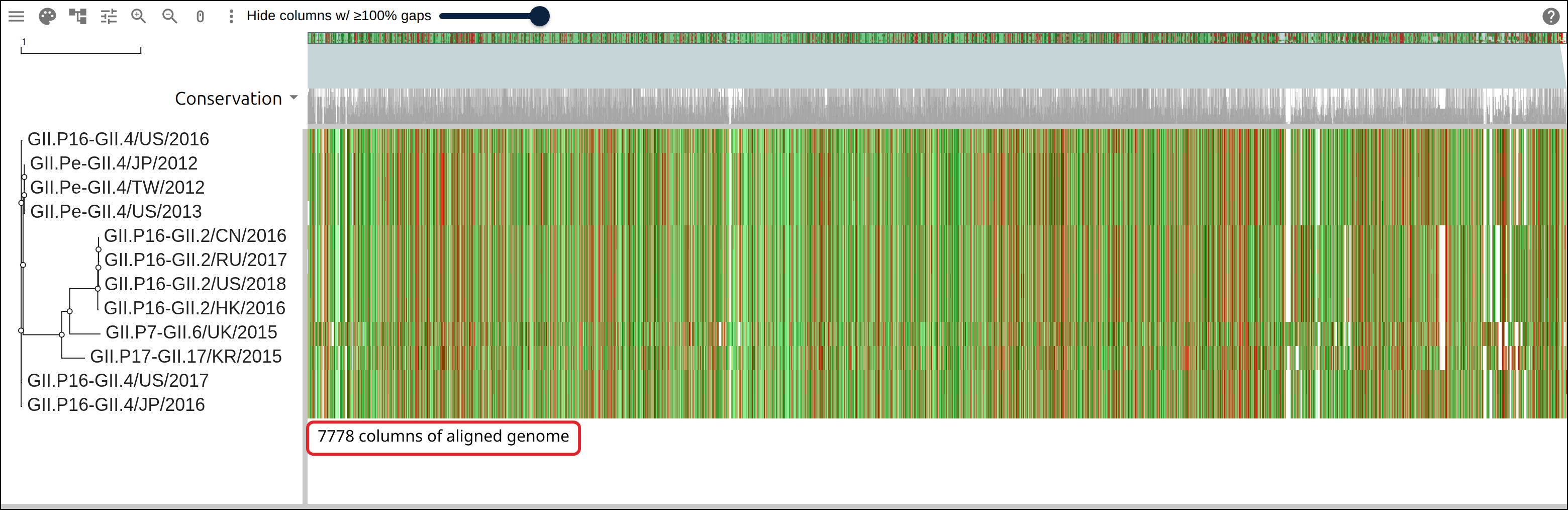
12 rows, 7778 columns, 2726 gap charactersThe twelve genomes take 7,778 columns between them, 208 more than the longest genome, and 2,726 gap characters spread over the twelve rows.
4. The ORFs on every row#
The GFF from step 2 carries each genome’s three ORFs in that genome’s own coordinates, so the viewer draws every row’s own spans and the indels between the rows shift them apart.
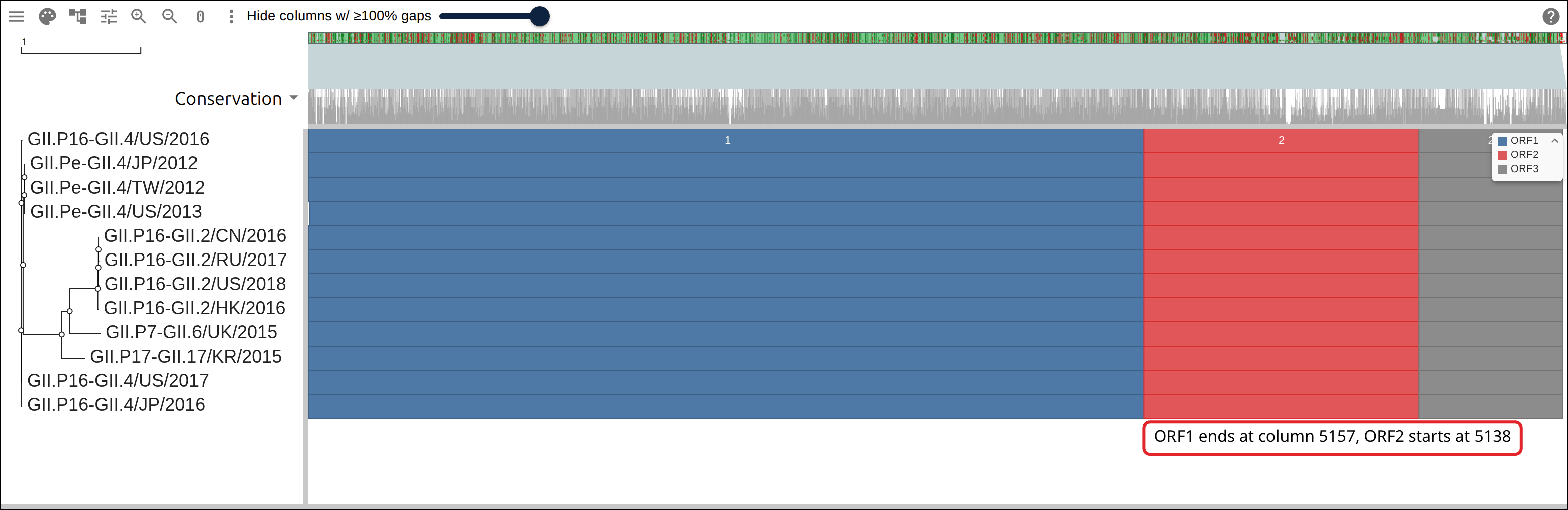
Reading the columns of one row turns those spans into column ranges for the alignment. GII.P16-GII.4/US/2016 is the row the rest of the page scans, and the columns of its ORFs bound the two per-ORF alignments the trees come from:
col_of_ref = [i for i, c in enumerate(seqs[REFERENCE]) if c != '-']
orf1 = (col(ref['ORF1'][0]), col(ref['ORF1'][1]))
orf2 = (col(ref['ORF2'][0]), col(ref['ORF2'][1]))
junction = (orf2[0] - FLANK, orf2[0] + FLANK)
in the alignment, GII.P16-GII.4/US/2016 has ORF1 in columns 5-5157 and ORF2 in columns 5138-6826
the junction cut is columns 4838-5437, 300 columns either side of the first base of ORF25. A tree per ORF#
FastTree runs twice, once on the ORF1 columns and once on the ORF2 columns:
for orf in orf1 orf2; do
  docker run --rm -v "$PWD:/work" -w /work quay.io/biocontainers/fasttree:2.2.0--h7b50bb2_1 \
    FastTree -nt -gtr -quiet -nosupport "noro-$orf.afa" > "noro-$orf.nwk"
done
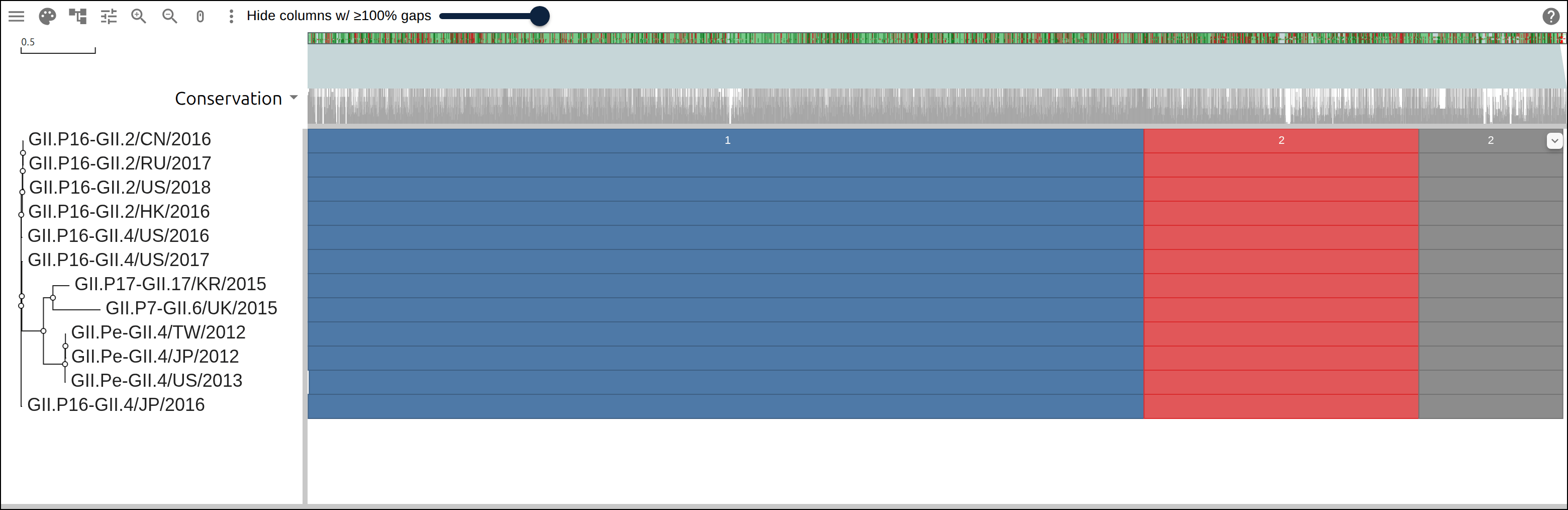
The two trees place GII.P16-GII.4/US/2016 differently. In the ORF1 tree it is the sister of the clade holding all four GII.P16-GII.2 rows, and the three GII.Pe-GII.4 rows sit behind a stem branch of 0.146. In the ORF2 tree its nearest neighbors are those three GII.Pe-GII.4 rows, 0.0093 away, and the GII.P16-GII.2 rows sit behind a branch of 0.323.
6. Which parent each row is closer to#
Percent identity over a span counts the columns where both rows carry a base:
def identity(query, subject, start, end):
    q, s = seqs[query], seqs[subject]
    both = matches = 0
    for i in range(start, end):
        if q[i] != '-' and s[i] != '-':
            both += 1
            matches += q[i] == s[i]
    return 100 * matches / both if both else 0
Over a whole ORF, that one number already separates the two parents:
GII.P16-GII.4/US/2016   ORF1  98.0% to GII.P16-GII.2/CN/2016,  77.5% to GII.Pe-GII.4/JP/2012   ORF2  64.8% and  96.3%
GII.Pe-GII.4/US/2013    ORF1  77.5% to GII.P16-GII.2/CN/2016,  98.8% to GII.Pe-GII.4/JP/2012   ORF2  64.4% and  98.6%
The recombinant reads 98.0% to the polymerase donor over ORF1 and 96.3% to the capsid donor over ORF2, and 64.8% to the polymerase donor over ORF2. The control reads the capsid donor at 98.8% and 98.6% over the two ORFs.
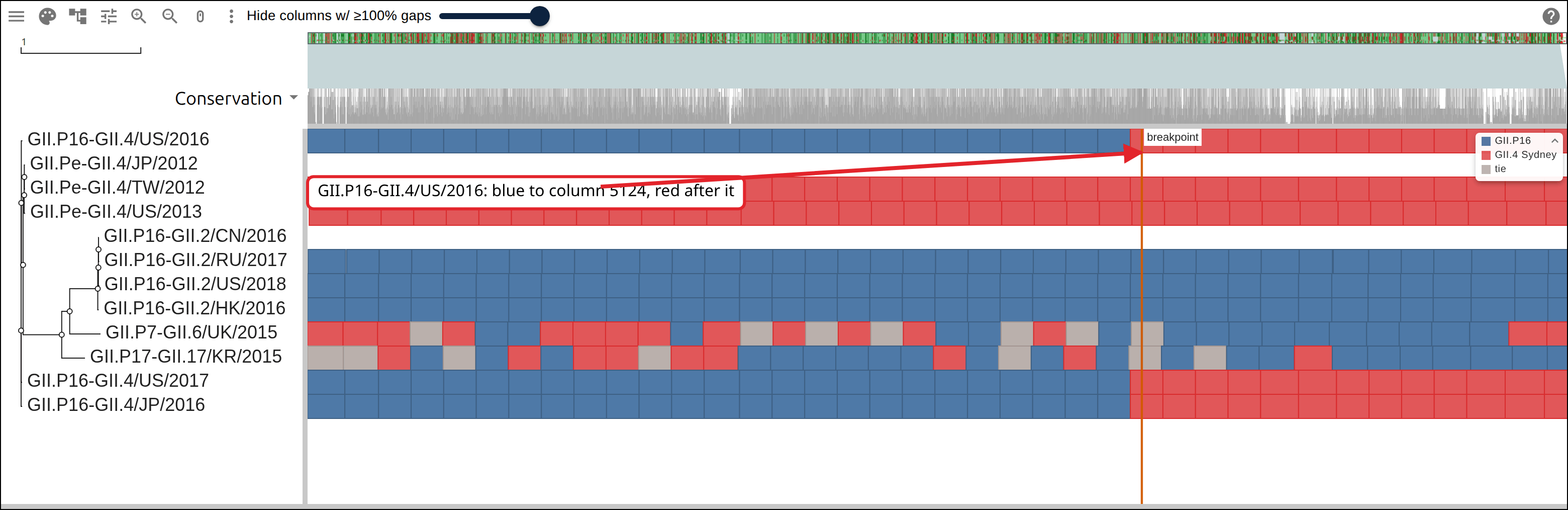
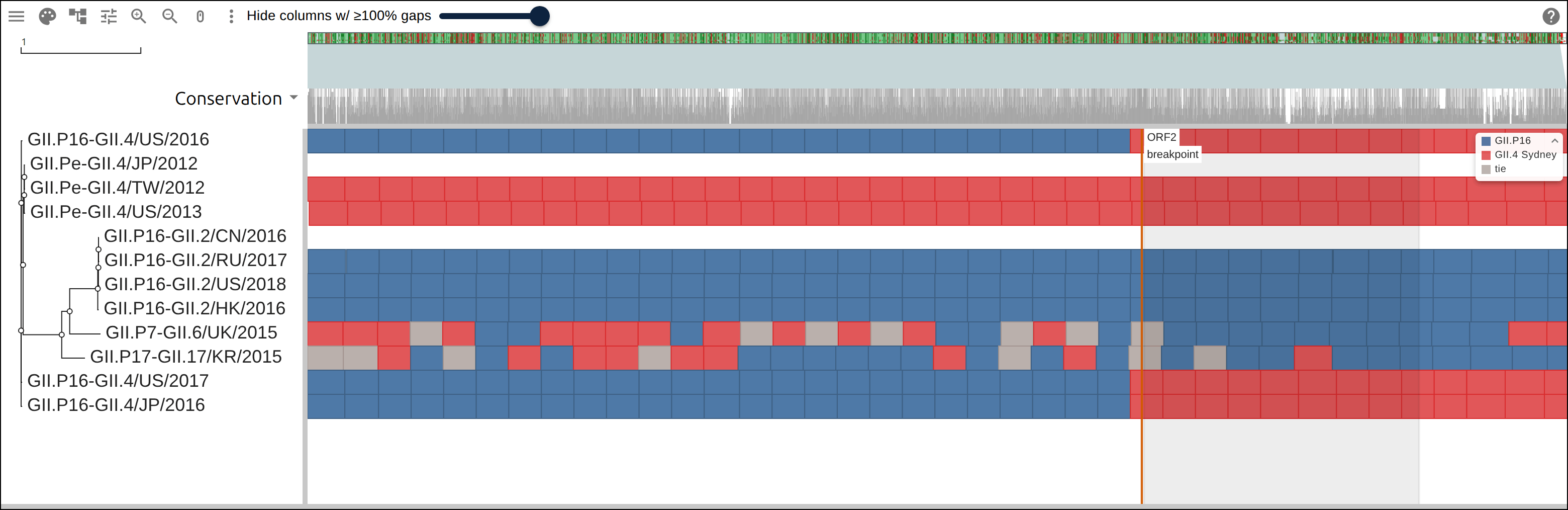
Running the same number in 200-base windows along every row gives a GFF the overlay colors by which parent won the window:
closer, color = (
    ('GII.P16', A_COLOR) if a - b > 1
    else ('GII.4 Sydney', B_COLOR) if b - a > 1
    else ('tie', TIE_COLOR)
)
7. The two curves across the junction#
A 200-base window is too coarse to place the join, so the tracks use a
100-column window stepped one column at a time, over the 600 columns of the
junction cut. A bar track holds one value per column of the file it is drawn
over, so the cut travels as a file of its own:
def track_values(row, subject):
    values = []
    for i in range(len(junction[row])):
        center = offset + i
        start = max(0, center - TRACK_WINDOW // 2)
        values.append(round(identity(row, subject, start, start + TRACK_WINDOW)))
    return values
GII.P16-GII.4/US/2016 to GII.P16-GII.2/CN/2016 (polymerase donor): 600 values, 62-100%
GII.P16-GII.4/US/2016 to GII.Pe-GII.4/JP/2012 (capsid donor): 600 values, 69-99%
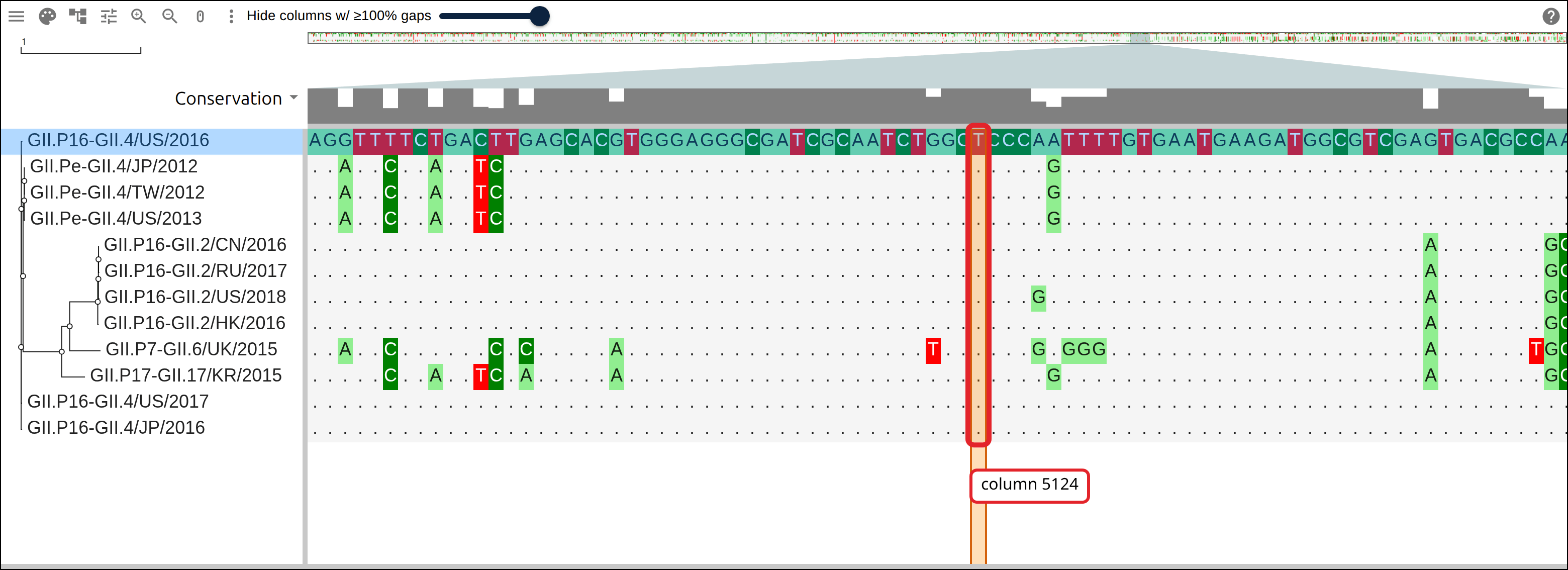
in the junction cut the GII.P16-GII.4/US/2016 curves change rank at column 287 of 600, column 5124 of the whole alignment
the two GII.P16-GII.4/US/2016 tracks take 6548 characters of a URL-encoded link, under the 8192-character request line the server answers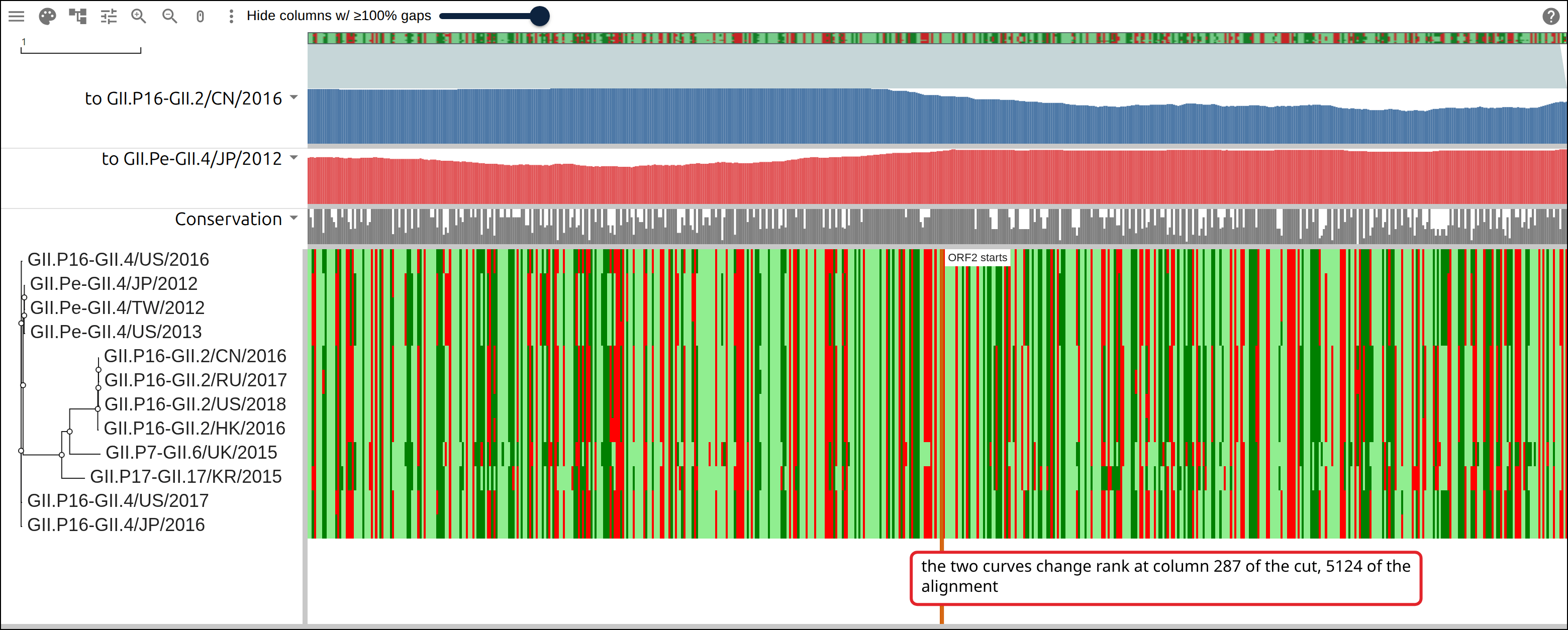
8. The control#
GII.Pe-GII.4/US/2013 carries the polymerase and the capsid of the same lineage as the capsid donor. The same pair of curves runs over the same 600 columns for that row.
GII.Pe-GII.4/US/2013 to GII.P16-GII.2/CN/2016 (polymerase donor): 600 values, 65-91%
GII.Pe-GII.4/US/2013 to GII.Pe-GII.4/JP/2012 (capsid donor): 600 values, 96-100%
the GII.Pe-GII.4/US/2013 curves change rank at 0 columns of the cut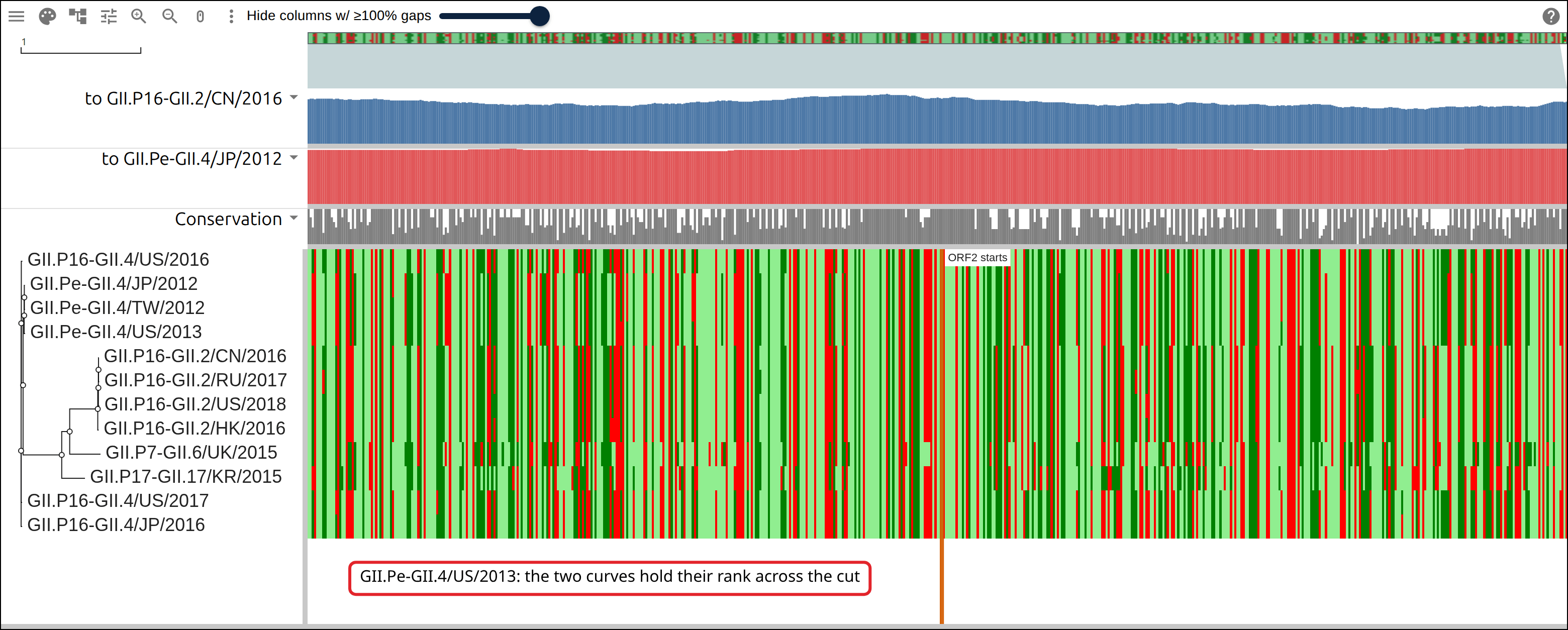
9. Check it against the bases#
Each percentage the curves draw comes from columns of the alignment. In the 500 columns either side of the crossing, the differences fall almost all on one parent per side:
GII.P16-GII.4/US/2016   the 500 columns before 5124: 7/500 differences to GII.P16-GII.2/CN/2016, 103/500 to GII.Pe-GII.4/JP/2012
GII.P16-GII.4/US/2016   the 500 columns after 5124: 142/500 differences to GII.P16-GII.2/CN/2016, 19/500 to GII.Pe-GII.4/JP/2012
GII.Pe-GII.4/US/2013    the 500 columns before 5124: 103/500 differences to GII.P16-GII.2/CN/2016, 7/500 to GII.Pe-GII.4/JP/2012
GII.Pe-GII.4/US/2013    the 500 columns after 5124: 138/500 differences to GII.P16-GII.2/CN/2016, 3/500 to GII.Pe-GII.4/JP/2012
The recombinant differs from the polymerase donor at 7 of the 500 columns before the crossing and at 142 of the 500 after it. The control differs from the capsid donor at 7 columns before and 3 after.
10. Open the whole thing#
Reproduce it end to end#
curl -O https://raw.githubusercontent.com/GMOD/JBrowseMSA/main/docs/tutorials/scripts/build_norovirus_recombination.sh
bash build_norovirus_recombination.sh
With no arguments the script writes the row table above and builds every file beside it, printing every number on this page. A whole run takes about a minute, most of it the two Docker pulls. Pass your own table to do the same for another set of genomes:
bash build_norovirus_recombination.sh my-rows.tsv out/The four labels at the top of the script name which row is the recombinant, which two are its parents and which is the control.
See also#
- The recombination breakpoint in XBB’s spike gene
- Eight mitochondrial genomes and the genes on them
- Data layers
- User guide
References#
- Ludwig-Begall LF, Mauroy A, Thiry E. Norovirus recombinants: recurrent in the field, recalcitrant in the lab. J Gen Virol 99:970-988.
- Cannon JL, Barclay L, Collins NR, et al. Genetic and epidemiologic trends of norovirus outbreaks in the United States from 2013 to 2016 demonstrated emergence of novel GII.4 recombinant viruses. J Clin Microbiol 55:2208-2221.
- Chhabra P, de Graaf M, Parra GI, et al. Updated classification of norovirus genogroups and genotypes. J Gen Virol 100:1393-1406.
- Katoh K, Standley DM. MAFFT multiple sequence alignment software version 7: improvements in performance and usability. Mol Biol Evol 30:772-780.
- Price MN, Dehal PS, Arkin AP. FastTree 2: approximately maximum-likelihood trees for large alignments. PLoS One 5:e9490.