Reading cross-reactivity off the kinase pocket
Imatinib was designed against one kinase, BCR-ABL1, and also inhibits half a dozen others (KIT, PDGFRA, CSF1R, LCK) well enough to matter clinically. Every human kinase folds the same ATP-binding pocket around the same three landmarks, so a drug built to fit one kinase’s pocket often fits several. This page aligns that pocket across the whole human kinase family and compares the residues at those landmarks between kinases imatinib inhibits and kinases it does not.
Prerequisites#
curl,python3- docker, to run HMMER and FastTree as biocontainers
(
quay.io/biocontainers/hmmer,quay.io/biocontainers/fasttree); both are also onaptandbrew
Where the data comes from#
The kinase list and the sequences are UniProt’s; the domain the alignment is built on is Pfam’s, as InterPro serves it.
- UniProt’s own classification of the human and mouse kinomes, release 2026_03: https://www.uniprot.org/docs/pkinfam.txt
- One UniProt sequence per accession, batched through the
/streamendpoint: https://rest.uniprot.org/uniprotkb/stream?query=accession:P00519&format=fasta - The Pfam protein kinase domain HMM, PF00069, as InterPro serves it: https://www.ebi.ac.uk/interpro/api/entry/pfam/PF00069/?annotation=hmm
- The alignment, tree and row metadata the figures below load, hosted so they can link to it: https://gmod.org/JBrowseMSA/demo/data/kinase-pocket/kinase-pocket.afa
- its tree: https://gmod.org/JBrowseMSA/demo/data/kinase-pocket/kinase-pocket.nwk
- and its row metadata (kinase group, UniProt accession): https://gmod.org/JBrowseMSA/demo/data/kinase-pocket/kinase-pocket-metadata.json
1. Name the human kinome#
UniProt has already grouped every human and mouse protein kinase by family. Keeping the HUMAN entries and the group each one sits under is a few lines of Python over the plain-text list:
import re

lines = open('pkinfam.txt').read().splitlines()
group = None
rows = []
i, n = 0, len(lines)
while i < n:
    line = lines[i]
    if re.fullmatch(r'=+', line.strip()) and i + 2 < n and re.fullmatch(r'=+', lines[i + 2].strip()):
        group = lines[i + 1].strip()
        i += 3
        continue
    m = re.match(r'^(\S+)\s+(\S+_HUMAN)\s+\((\w+)\s*\)', line)
    if m:
        gene, entry, acc = m.groups()
        rows.append((gene, acc, group))
    i += 1
print(len(rows))512512 entries across ten named groups (AGC, CAMK, CK1, CMGC, NEK, RGC, STE, TKL,
Tyr, Other) plus six small “Atypical” families that do not share the others’
fold. Tyr is the tyrosine kinases, ABL1 among them, and this page writes it as
TK, the name kinase biology usually uses for that group.
2. Fetch the sequences#
The script fetches one UniProt sequence per accession, 50 accessions per request:
import urllib.parse
import urllib.request

query = ' OR '.join(f'accession:{a}' for a in accessions[:50])
url = 'https://rest.uniprot.org/uniprotkb/stream?query=' + urllib.parse.quote(query) + '&format=fasta'
with urllib.request.urlopen(url) as resp:
    fasta_text = resp.read().decode()
The requests return 512 records for 512 accessions: every human kinase, full length.
3. Align the kinase domain#
A protein kinase carries regulatory regions, SH2/SH3 modules and transmembrane
spans outside its catalytic domain, and none of those line up across the family
the way the domain does. hmmalign against Pfam’s Pkinase model (PF00069)
extracts the domain and puts every kinase’s copy of it in the same 262 columns:
curl -sf "https://www.ebi.ac.uk/interpro/api/entry/pfam/PF00069/?annotation=hmm" |
  gzip -dc > pf00069.hmm

# score every candidate first, and keep only what clears Pfam's own gathering
# threshold. That drops the atypical, non-ePK-fold kinases (PI3/PI4-kinase,
# ADCK, alpha-type...) that would otherwise align to noise
docker run --rm -v "$PWD:/work" -w /work quay.io/biocontainers/hmmer:3.4--h7d74f8d_5 \
  hmmsearch --cut_ga --tblout hmmsearch.tbl -o hmmsearch.out pf00069.hmm all.fasta

docker run --rm -v "$PWD:/work" -w /work quay.io/biocontainers/hmmer:3.4--h7d74f8d_5 \
  hmmalign --trim --outformat afa -o kinase.afa pf00069.hmm kept.fasta
474 of the 512 entries clear the gathering threshold. Of the 38 that do not, 30
belong to the six “Atypical” families: PI3/PI4-kinases, ADCKs and the rest use a
related but different fold that this HMM does not model, so hmmsearch drops
them before alignment. --trim removes the unaligned tails outside the domain.
A following step strips the lowercase insert-state characters hmmalign leaves
in its a2m output, which reduces the alignment to the HMM’s fixed 262 columns;
all 474 rows come out exactly that length.
4. Build a tree#
FastTree builds the tree:
docker run --rm -v "$PWD:/work" -w /work quay.io/biocontainers/fasttree:2.2.0--h7b50bb2_1 \
  FastTree kinase-pocket.afa > kinase-pocket.nwk
Total time: 13.70 seconds Unique: 474/474 Bad splits: 0/471474 rows sits just under maxNeighborJoiningRows, the viewer’s 500-sequence cap
on its built-in neighbor joining. That neighbor joining is a distance method
with no model of amino acid substitution. FastTree fits one, and on 474
sequences it is also the faster of the two. Past the cap, the app’s error
message points to the
protein family tutorial.
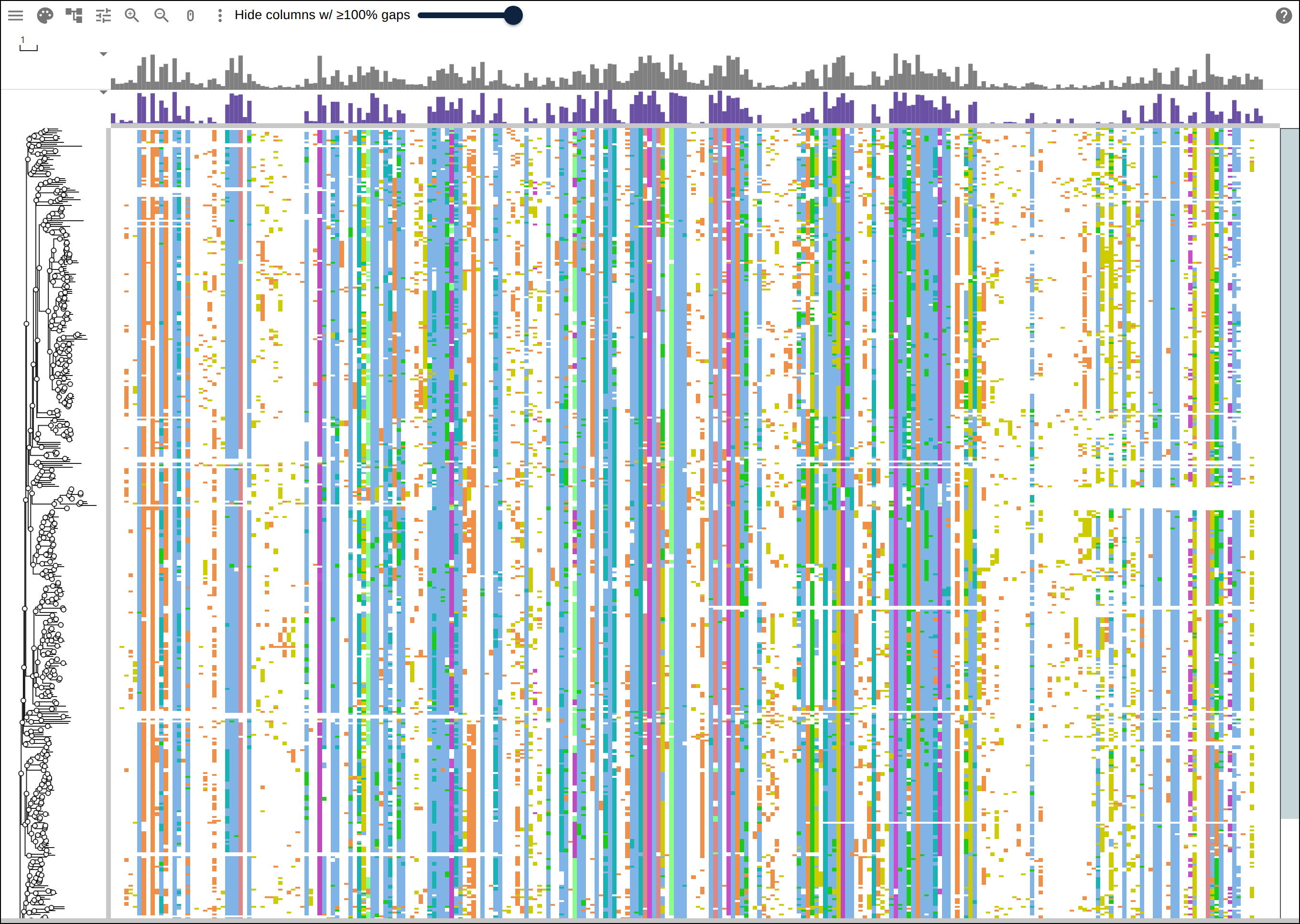
The tree orders the alignment’s rows by clade, so neighboring rows are related
kinases. Clicking any tip opens a node-info dialog with its row metadata from
kinase-pocket-metadata.json: the UniProt accession and the kinase group (TK,
CMGC and so on) that later steps refer to by name.
5. Read off the pocket#
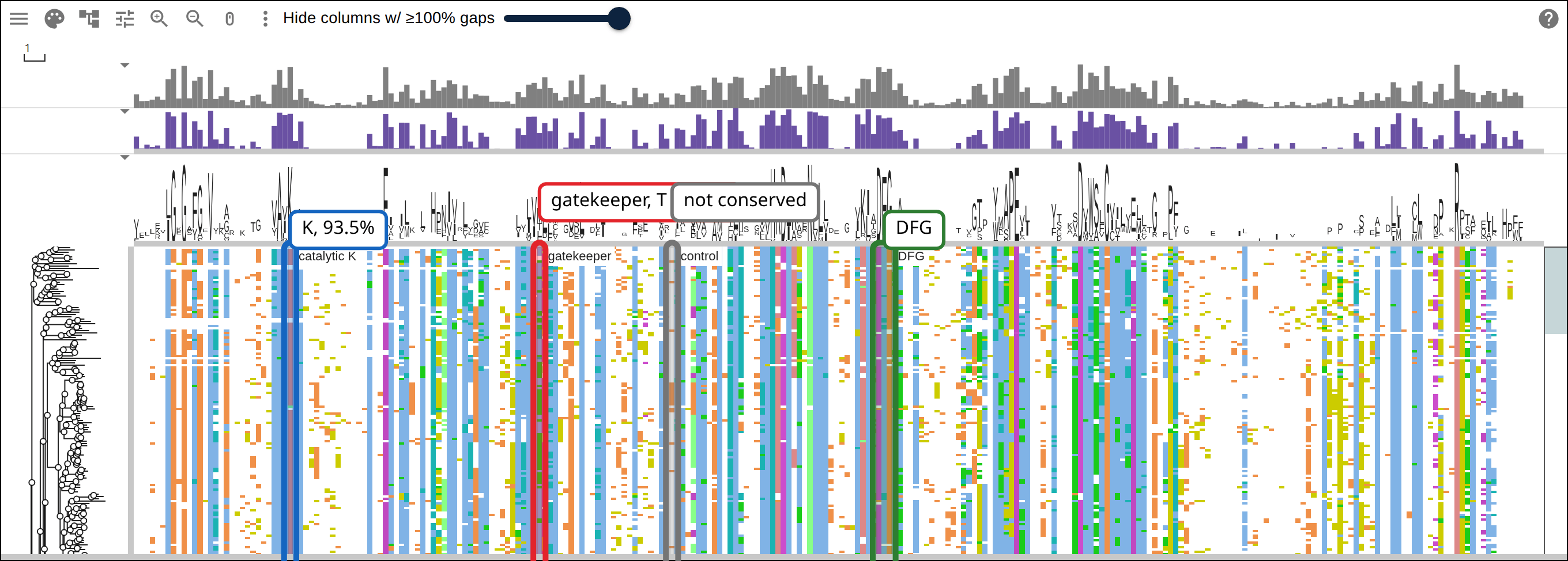
Three landmarks define the ATP pocket in every kinase family: a catalytic lysine that anchors ATP’s phosphates, a gatekeeper that sets how much room the back pocket has, and a DFG motif that switches the kinase between active and inactive conformations. Imatinib resistance mutations are usually reported in ABL1 numbering, as K271, T315 and D381-F382-G383. ABL1 is a row in this alignment, so walking its row gives the column of each landmark:
# ABL1's own row maps each of its residues to an alignment column, so one
# walk along it gives all three landmarks
full_abl1 = uniprot_sequence['ABL1']  # 1130 aa, P00519
aligned_abl1 = alignment['ABL1']       # 262 columns
Column 30 holds ABL1’s K271, column 77 its gatekeeper T315, and columns 141-143 its D381-F382-G383. A sequence logo across all 474 rows, with those three columns and one column with nothing to do with the pocket called out:
6. Compare the gatekeeper across two families#
A small gatekeeper (threonine) leaves the back pocket open, and a bulkier one (phenylalanine, methionine, leucine) fills it. Imatinib’s known targets, ABL1, ABL2, KIT, PDGFRA, CSF1R and LCK, all carry threonine at this position. The CDK family, which imatinib does not inhibit, carries phenylalanine:
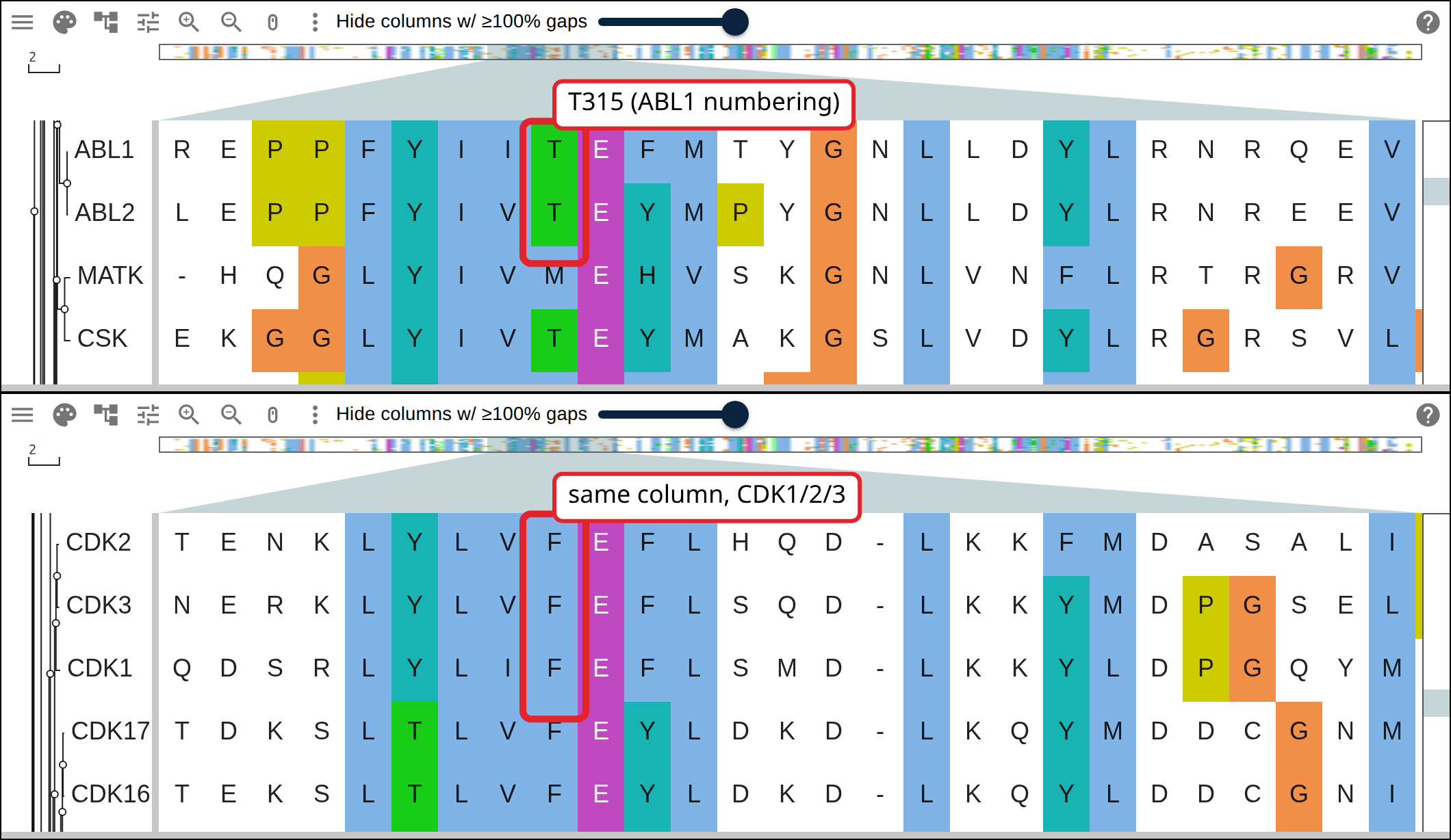
Both views show the same alignment column in two row bands from the same tree. ABL1 and ABL2 read threonine, and CDK1, CDK2 and CDK3 read phenylalanine. The flanking rows are MATK and CSK in the first band and CDK16 and CDK17 in the second. CDK16 and CDK17 carry threonine, although they sit next to CDK1-3 in the tree.
Check against the raw data#
The script tallies the gatekeeper column across all 474 rows:
from collections import Counter
counts = Counter(row[76] for row in alignment.values())  # column 77, 0-indexed
M 185 39.0%
T 90 19.0%
L 76 16.0%
F 69 14.6%
V 15 3.2%Threonine, the small gatekeeper that imatinib and similar drugs reach past,
occurs in 19.0% of these human kinase domains. KLIFS curates an 85-residue
kinase pocket from solved structures, independently of this alignment, and puts
the same position at 18.4% threonine over its 521 human kinase entries (96 of
them). KLIFS’ terms grant no license to redistribute, so this page hosts nothing
from it and queries its API live
(https://klifs.net/api/kinase_information?species=Human).
Reproduce it end to end#
curl -O https://raw.githubusercontent.com/GMOD/JBrowseMSA/main/docs/tutorials/scripts/build_kinase_pocket.sh
bash build_kinase_pocket.sh
With no arguments the script writes kinase-pocket.afa, kinase-pocket.nwk and
kinase-pocket-metadata.json in the working directory, printing every number
this page quotes. See Prerequisites for what it needs on
PATH.
See also#
References#
- Manning G, Whyte DB, Martinez R, Hunter T, Sudarsanam S. The protein kinase complement of the human genome. Science 298:1912-1934 (2002).
- Blum M, et al. InterPro: the protein sequence classification resource in 2025. Nucleic Acids Research 53:D444-D456.
- Eddy SR. Accelerated profile HMM searches. PLoS Computational Biology 7:e1002195 (2011).
- Price MN, Dehal PS, Arkin AP. FastTree 2: approximately maximum-likelihood trees for large alignments. PLoS ONE 5:e9490 (2010).
- Kooistra AJ, Kanev GK, van Linden OP, Leurs R, de Esch IJ, de Graaf C. KLIFS: a structural kinase-ligand interaction database. Nucleic Acids Research 44:D365-D371 (2016).