Gene neighborhoods of the tryptophan operon
The tryptophan pathway is one operon in Escherichia coli and a scattered set
of genes in others. This page takes twelve RefSeq bacterial genomes, cuts 8 kb
either side of trpB out of each, and draws the result as one row of strand
arrows per genome beside a tree built from the TrpB protein. The panel reads
each row in that genome’s own coordinates, so an align transform on trpE
brings the rows onto a common origin, and the two genomes that carry no trpE
stay where they were.
Prerequisites#
curl,python3, and ClustalW (apt install clustalw)- twelve whole-genome annotations, about 3 MB each; NCBI takes 20 to 30 seconds to serve one, and the script caches them
- nothing to read along: every figure below links to the live view it captured
Where the data comes from#
RefSeq’s own annotation of each genome, and the three files this page writes from it.
- one GFF3 per genome, from the NCBI sequence viewer, for example https://www.ncbi.nlm.nih.gov/sviewer/viewer.fcgi?id=NC_000913.3&report=gff3&retmode=text
- the TrpB proteins, from NCBI efetch by the
protein_idon each trpB CDS line - the neighborhood GFF this page writes, 176 genes over twelve rows: https://gmod.org/JBrowseMSA/demo/data/neighborhoods/trp-neighborhoods.gff
- the TrpB alignment: https://gmod.org/JBrowseMSA/demo/data/neighborhoods/trpB.afa
- its tree: https://gmod.org/JBrowseMSA/demo/data/neighborhoods/trpB.nwk
1. The window around trpB#
The row list is twelve accessions and the label each becomes:
NC_000913.3	E_coli
NC_003143.1	Y_pestis
NC_002505.1	V_cholerae
...
RefSeq serves the whole annotation for each, and the script cuts the window itself. trpB is the anchor because every genome here carries exactly one, and the window is turned so that trpB points right, so a genome whose operon runs on the minus strand reads the same way as one on the plus strand:
flip = b['strand'] == '-'
origin = b['end'] if flip else b['start']
lo, hi = origin - flank, origin + flank
inside = [g for g in genes if g['start'] >= lo and g['end'] <= hi]
Position 1 of each window is the first base of its first whole gene, not the base 8,000 before trpB, so no row is placed by where the cut fell:
base = rows[0][0] - 1
rows = [(s - base, e - base, strand, g) for s, e, strand, g in rows]
bash build_gene_neighborhoods.sh trp-rows.tsv . row genome genes window trp genes, 5' to 3'
E_coli 4651 17 14150 trpL trpE trpD trpC trpB trpA
Y_pestis 4209 15 14581 trpE trpD* trpCF trpB trpA
V_cholerae 2697 14 14865 trpL trpE trpG trpD trpCF trpB trpA
S_oneidensis 4464 14 15092 trpE trpG trpD trpCF trpB trpA
H_influenzae 1801 19 14560 trpB trpA
P_aeruginosa 5697 12 10742 trpB trpA
H_pylori 1603 13 15251 trpE trpG trpD trpCF trpB trpA
B_subtilis 4536 15 15382 trpE trpD trpC* trpF trpB trpA
S_aureus 2872 14 14755 trpE trpG trpD trpC trpF trpB trpA
C_glutamicum 3079 14 14719 trpL trpE trpG trpD trpCF trpB trpA
M_tuberculosis 4008 16 15224 trpE trpC trpB trpA
B_thetaiotaomicron 4848 13 15298 trpB trpE trpG trpD trpC trpF trpA
176 genes: trp 63, regulator 4, pseudogene 6, other 103
16 names come from the product table, the rest from RefSeq
* RefSeq annotates the gene as a pseudogeneTen of the twelve windows hold both trpE and trpA. Haemophilus influenzae and Pseudomonas aeruginosa hold trpB and trpA and nothing else of the pathway, so the rest of their tryptophan genes sit somewhere the window does not reach.
RefSeq gives many of these genes a product and no gene symbol, and the script reads a symbol off eleven product strings, which names 16 of the 176 genes:
PRODUCT_SYMBOL = [
    ('anthranilate synthase component II', 'trpG'),
    ('anthranilate synthase component I', 'trpE'),
    ('indole-3-glycerol phosphate synthase', 'trpC'),
    ('tryptophan synthase subunit beta', 'trpB'),
    ('tryptophan synthase subunit alpha', 'trpA'),
]
Each gene becomes a GFF3 line at its position inside the window, carrying its name, its role and the locus tag it came from:
##gff-version 3
E_coli	RefSeq	gene	1	621	.	-	.	Name=yciO;role=other;locus_tag=b1267
E_coli	RefSeq	gene	618	1499	.	-	.	Name=rnm;role=other;locus_tag=b1266
2. The marker, and the tree#
TrpB is the one protein every genome here carries, so it is both the anchor of
the window and the marker the tree is built from. The script fetches all twelve
by the protein_id on the trpB CDS line and aligns them:
clustalw -INFILE=trpB.fasta -ALIGN -TYPE=PROTEIN -OUTPUT=FASTA -OUTFILE=trpB.afa
clustalw -INFILE=trpB.afa -TREE -TYPE=PROTEIN -OUTPUTTREE=phylip
E_coli NP_415777.1 397 aa
Y_pestis WP_002210633.1 396 aa
...
C_glutamicum WP_004567953.1 417 aa
Alignment Score 95830
423 columnsThe twelve proteins run 393 to 417 residues and align into 423 columns.
3. The neighborhood as a features panel#
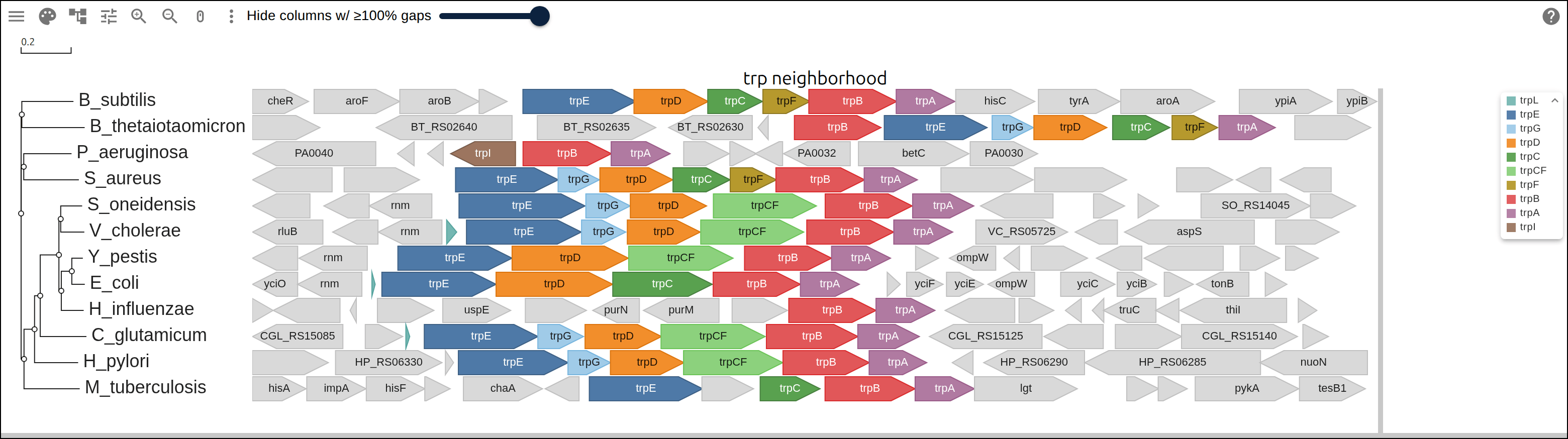
A rowPanels record of kind features draws the GFF’s spans per row.
x: "position" reads each row in its own residue positions, which is the scale
a genome window is on, and the panel packs the spans into lanes per row:
"rowPanels": [
  {
    "kind": "features",
    "x": "position",
    "width": 1120,
    "header": "trp neighborhood",
    "encoding": {
      "color": { "field": "Name", "scale": { "map": { "trpE": "#4e79a7" } } },
      "label": "Name"
    }
  }
]
The panel’s encoding reads the feature table, so color names a GFF attribute
and a map over it. A gene the map leaves out draws grey, so a map of ten trp
names colors 66 of the 176 genes and leaves the other 110 as grey arrows.
label draws the same attribute inside each arrow wherever the text fits.
This view carries a tree and a GFF and no alignment at all. The alignment panel is zero columns wide, and the conservation, logo and ruler tracks all measure columns, so none of them draws.
4. Aligning every row on trpE#
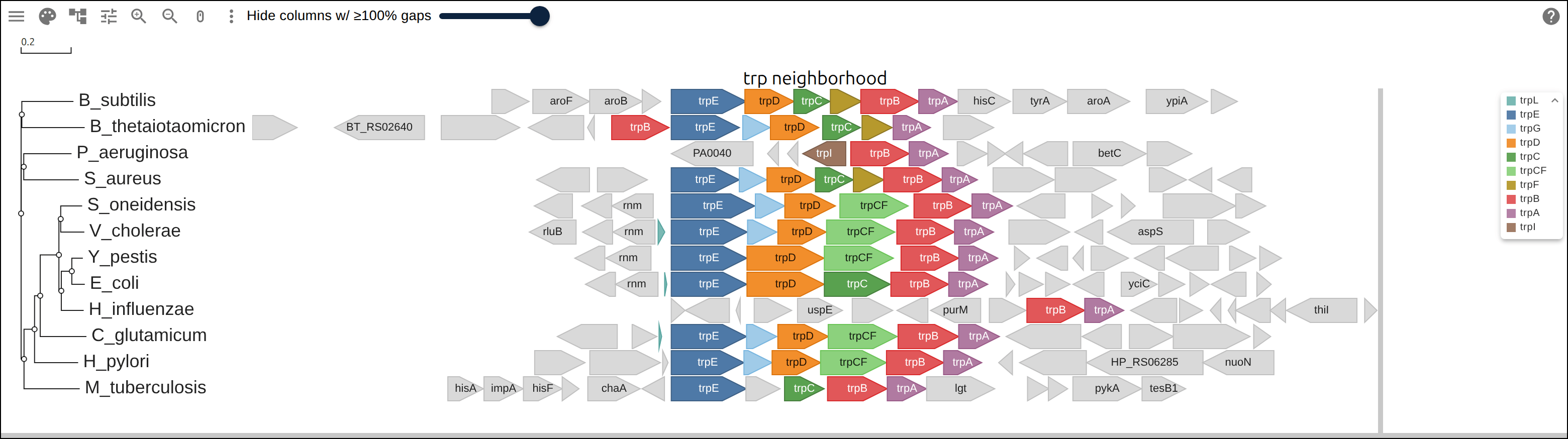
An align transform shifts each row so that the first feature named on starts
at zero, which is gggenes’ make_alignment_dummies:
"transform": [{ "type": "align", "on": "trpE" }]The script computes the same shift per row, and prints where trpD lands once it is applied:
  E_coli              trpE at 1773, shift -1772: trpD starts at 1562 (genes between: none)
  Y_pestis            trpE at 1992, shift -1991: trpD starts at 1562 (genes between: none)
  V_cholerae          trpE at 2930, shift -2929: trpD starts at 2200 (genes between: trpG)
  S_oneidensis        trpE at 2828, shift -2827: trpD starts at 2343 (genes between: trpG)
  H_influenzae        no trpE in the window, keeps its own origin
  P_aeruginosa        no trpE in the window, keeps its own origin
  H_pylori            trpE at 2819, shift -2818: trpD starts at 2080 (genes between: trpG)
  B_subtilis          trpE at 3702, shift -3701: trpD starts at 1519 (genes between: none)
  S_aureus            trpE at 2780, shift -2779: trpD starts at 1975 (genes between: trpG)
  C_glutamicum        trpE at 2353, shift -2352: trpD starts at 2199 (genes between: trpG)
  M_tuberculosis      trpE at 4610, no trpD in the window
  B_thetaiotaomicron  trpE at 8644, shift -8643: trpD starts at 2046 (genes between: trpG)
trpD starts at 1562 in E. coli and in Yersinia pestis, where it follows trpE directly. In the six rows that carry a trpG between them it starts between 1975 and 2343, the length of that gene further along.
5. The same spans colored by role#
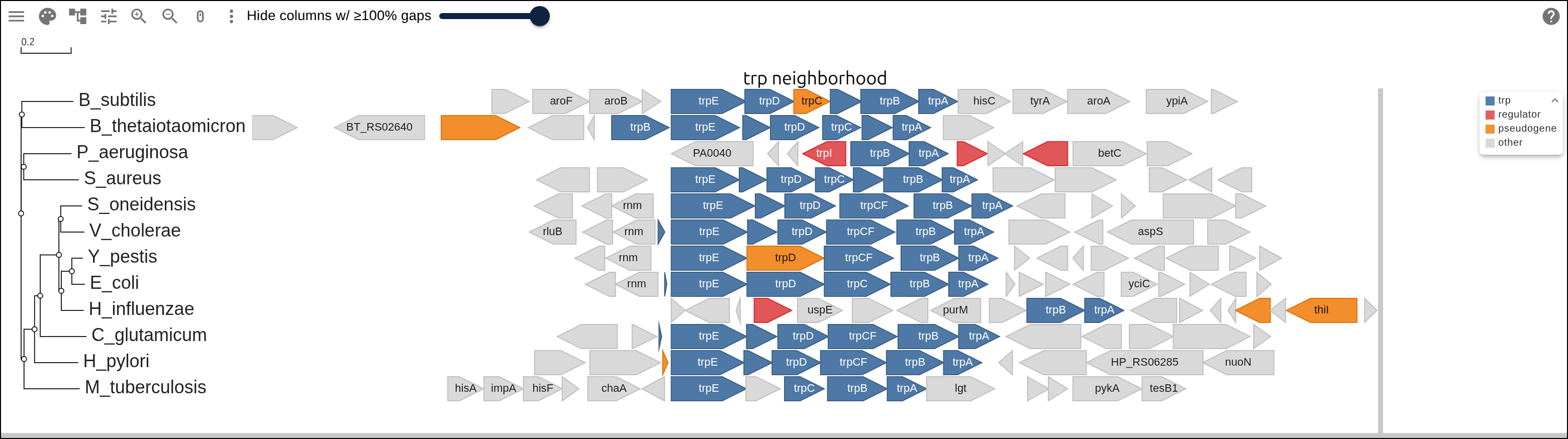
encoding is the panel’s own, so a second figure over the same GFF reads a
different attribute. The script writes a role of trp, regulator,
pseudogene or other on every line:
"encoding": {
  "color": { "field": "role", "scale": { "map": { "trp": "#4e79a7" } } },
  "label": "Name"
}
6. The panel beside the alignment it came from#
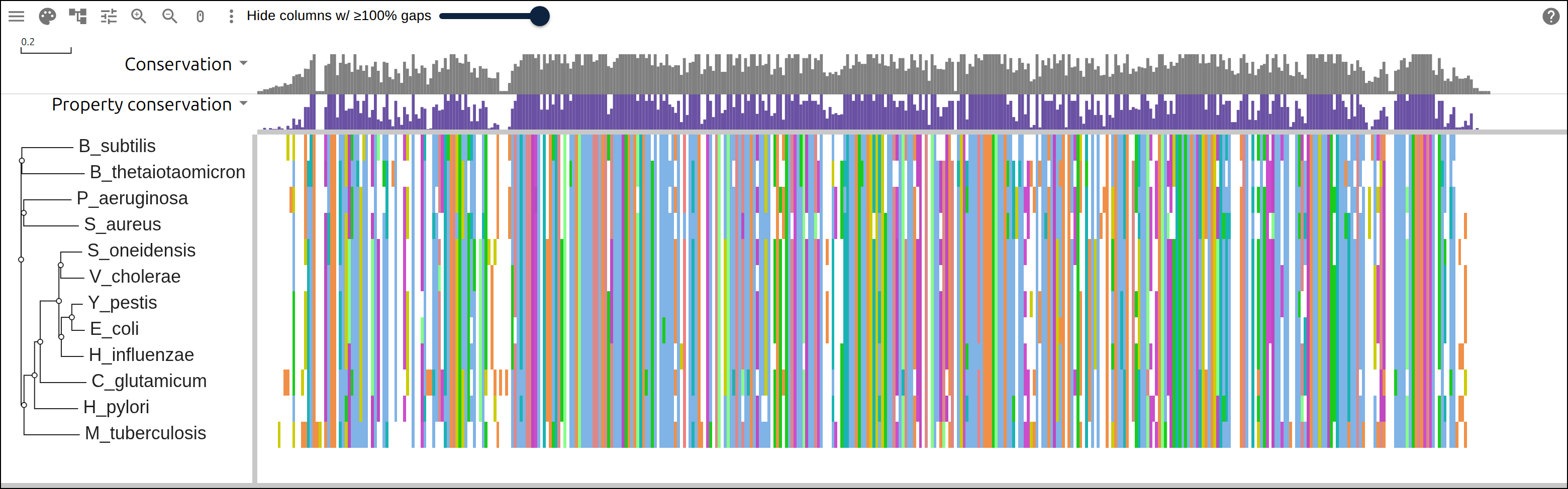
The panel and the alignment are two views of the same twelve rows, so both fit in one figure. The panel takes its width out of the alignment’s, and the alignment scrolls and fits within what is left:
{
  "msaFilehandle": { "uri": "data/neighborhoods/trpB.afa" },
  "treeFilehandle": { "uri": "data/neighborhoods/trpB.nwk" },
  "gffFilehandle": { "uri": "data/neighborhoods/trp-neighborhoods.gff" },
  "showDomains": false,
  "rowPanels": [{ "kind": "features", "x": "position", "width": 760 }]
}
The GFF’s positions are genome coordinates, so showDomains is off: the
alignment’s own overlay reads a GFF span as residues of the row, and 1,562 would
land far past the 423rd column.
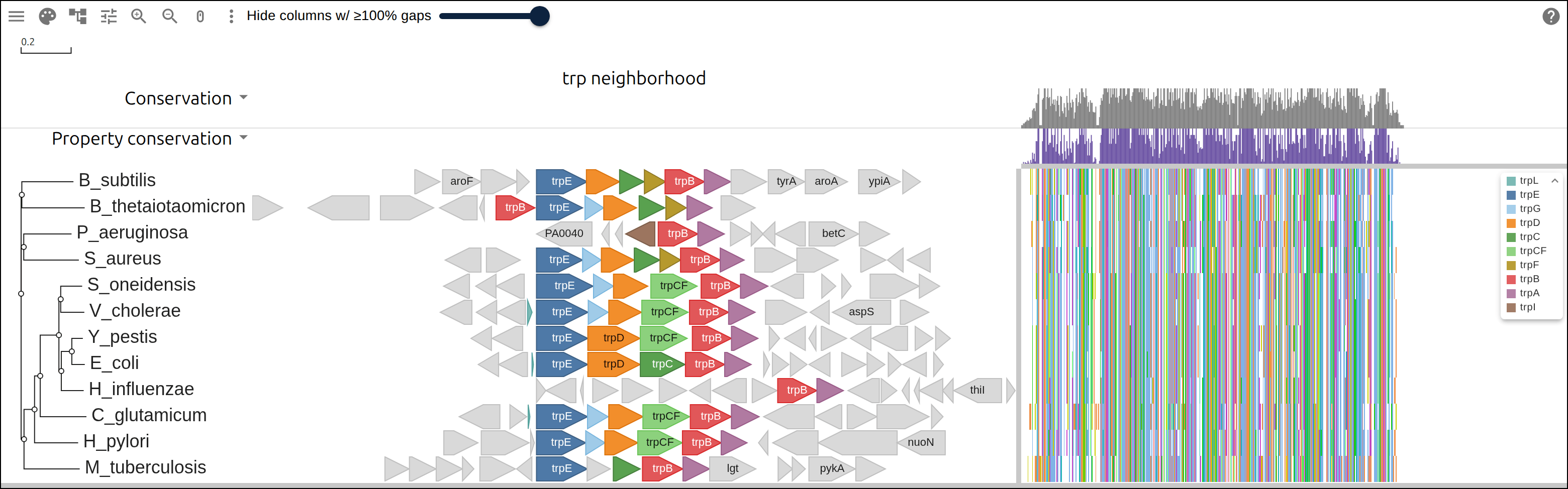
Two rows never moved. H. influenzae and P. aeruginosa carry trpB and trpA in their windows and nothing else of the pathway, so they have no trpE to align on. RefSeq places the rest of their tryptophan genes elsewhere in each genome, past the 8 kb the window reaches, and the figure leaves both rows on their own origin.
Reproduce it end to end#
curl -O https://raw.githubusercontent.com/GMOD/JBrowseMSA/main/docs/tutorials/scripts/build_gene_neighborhoods.sh
bash build_gene_neighborhoods.sh
The script writes the twelve-row TSV itself when none is given, so it runs with
no arguments. It fetches each annotation into raw/, where a rerun finds it,
and writes trp-neighborhoods.gff, trpB.afa and trpB.nwk beside it, along
with every number on this page.
See also#
References#
- Yu G, Smith DK, Zhu H, Guan Y, Lam TT. ggtree: an R package for visualization and annotation of phylogenetic trees with their covariates and other associated data. Methods Ecol Evol 8:28-36.
- Thompson JD, Gibson TJ, Higgins DG. Multiple sequence alignment using ClustalW and ClustalX. Curr Protoc Bioinformatics Chapter 2:Unit 2.3.
- O’Leary NA, Wright MW, Brister JR, et al. Reference sequence (RefSeq) database at NCBI: current status, taxonomic expansion, and functional annotation. Nucleic Acids Res 44:D733-D745.