The SARS-CoV-2 furin insert and PDB 6VXX
The SARS-CoV-2 spike protein carries four residues, PRRA, that its closest relatives do not, and they sit where the protein gets cut in two. The first cryo-EM structure of the trimer, PDB 6VXX, was solved from a construct with that site engineered away, and the loop carrying it has no coordinates in the deposited model. This page aligns eleven coronavirus spikes, puts the four residues on the alignment, and then maps each residue of the SARS-CoV-2 row to the structure to find which ones 6VXX resolved. The link carries the result as data: the alignment, the tree, the domains, and a correspondence between one row and one chain.
Prerequisites#
curlandjq- python3, for the build script’s JSON lookups
- MAFFT,
apt install maffton Debian or Ubuntu,brew install maffton macOS - FastTree,
apt install fasttree, orbrew install fasttree - react-msaview-cli for the domain GFF,
npm install -g react-msaview-cli, NodeJS v22+ - nothing to read along: every figure below links to the live view it captured
Where the data comes from#
Eleven spike glycoproteins as NCBI holds them, the UniProtKB entry for the SARS-CoV-2 one, InterPro release 110.0 for the domains, and PDBe for everything about the structure.
- all eleven protein sequences, one request: https://eutils.ncbi.nlm.nih.gov/entrez/eutils/efetch.fcgi?db=protein&id=YP_009724390.1&rettype=fasta&retmode=text
- the UniProtKB entry, for its sequence and its feature table: https://rest.uniprot.org/uniprotkb/P0DTC2.json
- precomputed Pfam matches for one accession: https://www.ebi.ac.uk/interpro/api/entry/pfam/protein/uniprot/P0DTC2/
- the SIFTS residue correspondence between UniProt and the PDB entry: https://www.ebi.ac.uk/pdbe/api/mappings/uniprot/6vxx
- which residues of chain A have coordinates: https://www.ebi.ac.uk/pdbe/api/pdb/entry/polymer_coverage/6vxx/chain/A
- the sequence the entry deposited, tags included: https://www.ebi.ac.uk/pdbe/api/pdb/entry/molecules/6vxx
- the structure itself, for a structure viewer: https://files.rcsb.org/download/6VXX.cif
- the alignment the commands below write, hosted so the figures can link to it: https://gmod.org/JBrowseMSA/demo/data/spike/spike.afa
- its tree: https://gmod.org/JBrowseMSA/demo/data/spike/spike.nwk
- its domains: https://gmod.org/JBrowseMSA/demo/data/spike/spike-domains.gff
- the three layers, as the build script wrote them: https://gmod.org/JBrowseMSA/demo/data/spike/spike-layers.json
Every API endpoint here serves a single record per request and sends
Access-Control-Allow-Origin: *.
1. Name the rows#
The row table has three columns: the NCBI protein the alignment uses, the label the viewer draws, and the UniProtKB entry for the same protein where one exists.
YP_009724390.1	SARS-CoV-2	P0DTC2
QHR63300.2	RaTG13	A0ABF7PLN6
UAY13217.1	BANAL-20-52	-
QIA48632.1	Pangolin-GX	-
NP_828851.1	SARS-CoV	P59594
YP_009047204.1	MERS-CoV	K9N5Q8
YP_001039953.1	HKU4	A3EX94
YP_173238.1	HKU1	Q0ZME7
YP_009555241.1	OC43	P36334
NP_073551.1	229E	P15423
YP_003767.1	NL63	Q6Q1S2
Save that as rows.tsv. The separators are tabs. The label travels through the
whole page: it becomes the FASTA defline, the tree tip, the GFF seq_id, and
the row field of every layer, and the viewer matches them to each other by it.
InterPro keys its precomputed matches by the third column. A - means UniProtKB
has no entry for that isolate’s spike: BANAL-20-52 is the Laos bat virus from
Temmam et al., Pangolin-GX is the GX-P5L isolate, and both exist only as GenBank
records.
2. Fetch the sequences#
Fetch all eleven in one request, then relabel each record by virus:
# a comma-separated id list fetches all eleven in one efetch call
ids=$(cut -f1 rows.tsv | paste -sd,)
curl -sf "https://eutils.ncbi.nlm.nih.gov/entrez/eutils/efetch.fcgi\
?db=protein&id=$ids&rettype=fasta&retmode=text" -o spike-ncbi.fasta
Read the lengths before aligning anything:
SARS-CoV-2   YP_009724390.1   1273 aa
RaTG13       QHR63300.2       1269 aa
BANAL-20-52  UAY13217.1       1269 aa
Pangolin-GX  QIA48632.1       1267 aa
SARS-CoV     NP_828851.1      1255 aa
MERS-CoV     YP_009047204.1   1353 aa
HKU4         YP_001039953.1   1352 aa
HKU1         YP_173238.1      1356 aa
OC43         YP_009555241.1   1353 aa
229E         NP_073551.1      1173 aa
NL63         YP_003767.1      1356 aa
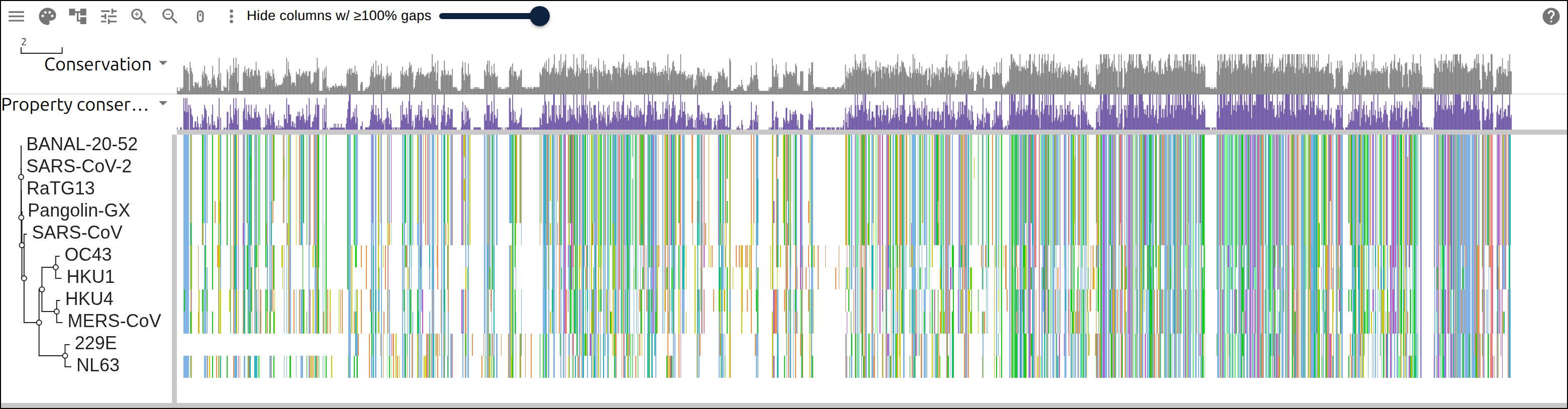
All eleven are full-length spikes of 1173 to 1356 residues. The four sarbecoviruses at the top are within six residues of each other, and the rest differ from them by up to 180 residues. A truncated fragment or a stray polyprotein would show up in this list as an outlying length.
3. Align them#
mafft --auto spike.fasta > spike.afa--auto picks its strategy from the size of the input, and on eleven sequences
MAFFT reports choosing L-INS-i, the accurate and slow one. The run takes five
seconds and writes 1660 columns, 304 more than the longest input, to hold the
insertions.
4. Infer a tree#
# -lg is the amino-acid substitution model; the Newick goes to stdout and the
# progress to stderr
FastTree -lg spike.afa > spike.nwk
(SARS-CoV-2:0.007478676,BANAL-20-52:0.004978619,(RaTG13:0.009142493,
(Pangolin-GX:0.038420176,(SARS-CoV:0.140352604,((229E:0.227306296,
NL63:0.306929144)1.000:1.267772518,((MERS-CoV:0.289975358,HKU4:0.170994428)...The four sarbecoviruses sit on branches of 0.005 to 0.04 while the two alphacoronaviruses are at 0.23 and 0.31, so most of the tree’s width separates 229E and NL63 from the other rows.
5. Ask InterPro for the domains#
InterPro precomputes the matches for every UniProtKB sequence, so no scan is needed. The matches use the UniProtKB entry’s numbering, and these rows are NCBI records, so the entry has to be the same protein as the row before its coordinates apply to it:
# same length means substitutions only, so residue n is residue n in both;
# a length difference is an indel, and every boundary after it has moved
curl -sf "https://rest.uniprot.org/uniprotkb/P0DTC2.fasta" |
tail -n +2 | tr -d '\n' | wc -c1273The SARS-CoV-2 row is also 1273 residues. The same check for every row with an accession:
SARS-CoV-2   P0DTC2 same length, 0 substitution(s)
RaTG13       A0ABF7PLN6 same length, 0 substitution(s)
BANAL-20-52  no UniProtKB entry, so no precomputed matches
Pangolin-GX  no UniProtKB entry, so no precomputed matches
SARS-CoV     P59594 same length, 1 substitution(s)
MERS-CoV     K9N5Q8 same length, 2 substitution(s)
HKU4         A3EX94 same length, 0 substitution(s)
HKU1         Q0ZME7 is 1351 aa against the row's 1356, so its numbering is not the row's: dropped
OC43         P36334 same length, 2 substitution(s)
229E         P15423 same length, 0 substitution(s)
NL63         Q6Q1S2 same length, 0 substitution(s)
Eight rows pass. The HKU1 RefSeq protein and the HKU1 UniProt entry are different isolates five residues apart in length, and the domains of one placed on the other would be off by five past the indel.
The eight go into spike-uniprot.tsv, one accession and label per line, which
the CLI reads:
react-msaview-cli interpro spike-uniprot.tsv -o spike-domains.gffInterPro release 110.0; reading precomputed pfam matches...
[1/8] P0DTC2: 4 pfam entries
...
8 fetched, 0 from /home/you/.cache/react-msaview-cli/interpro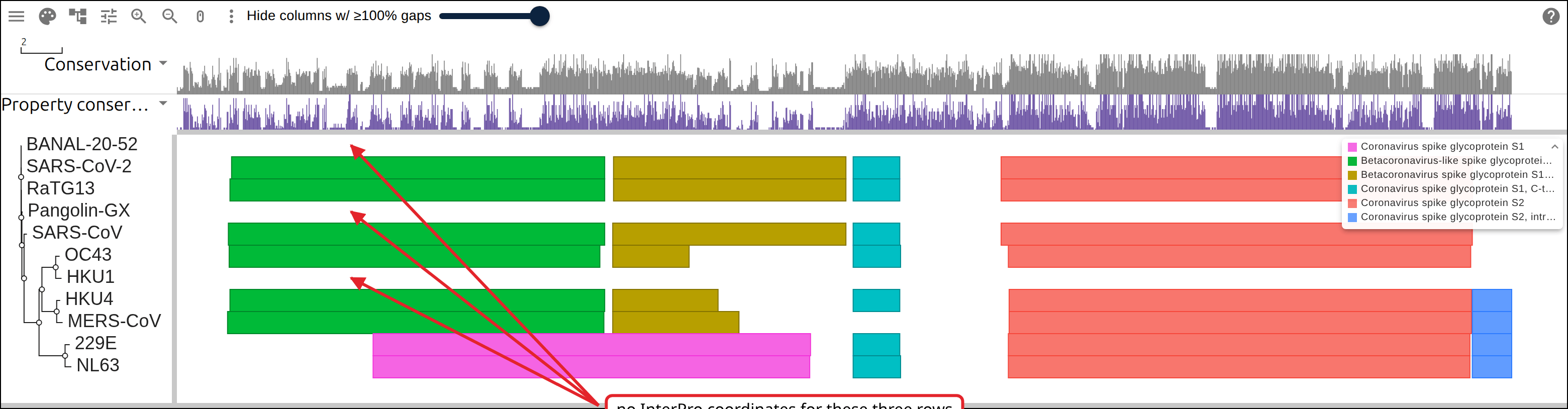
6. The PRRA insert#
No feature table annotates the insert, since it is defined by what the other sequences lack. Find it in the sequence:
awk '/^>SARS-CoV-2/{getline; print index($0, "PRRA")}' spike.fasta681The insert is residues 681 to 684, in alignment columns 992 to 995. A
highlights entry in residue coordinates puts a labeled band on them, and the
viewer converts the coordinates to columns:
"highlights": [
  { "row": "SARS-CoV-2", "start": 681, "end": 684, "label": "PRRA insert" },
  { "row": "SARS-CoV-2", "start": 685, "end": 686, "label": "Furin cleavage" }
]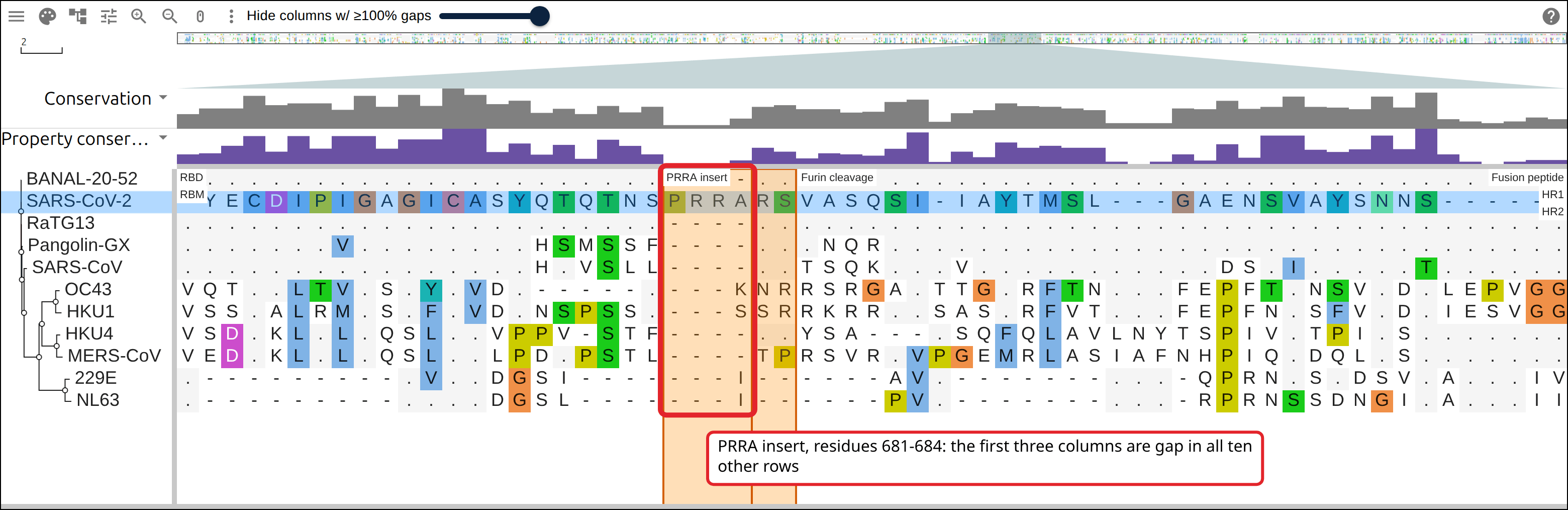
Columns 992, 993 and 994 are gap in all ten other rows. Column 995 is gap in six of them and carries S in HKU1, K in OC43, and I in both 229E and NL63, the four rows furthest from SARS-CoV-2 in the tree. The column immediately after the insert, 996, is R685 here and an R in every other betacoronavirus row, so the arginine is shared and the four residues before it are not.
7. Residues resolved in 6VXX#
A PDB entry numbers its residues its own way, so SIFTS supplies the correspondence between residues of the row and residues of the structure:
curl -s https://www.ebi.ac.uk/pdbe/api/mappings/uniprot/6vxx |
  jq -c '.["6vxx"].UniProt.P0DTC2.mappings[] | select(.chain_id == "A") |
         {unp_start, unp_end, start: .start.residue_number,
end: .end.residue_number, identity}'{"unp_start":14,"unp_end":1211,"start":33,"end":1230,"identity":0.97}SIFTS returns one block, offset by 19 for its whole length, with an identity of 0.97. The construct accounts for both, and the entry describes it:
curl -s https://www.ebi.ac.uk/pdbe/api/pdb/entry/molecules/6vxx |
  jq -r '.["6vxx"][0] | .length, .sequence[:32], .sequence[-51:]'
1281
MGILPSPGMPALLSLVSLLSVLLMGCVAETGT
GSGRENLYFQGGGGSGYIPEAPRDGQAYVRKDGEWVLLSTFLGHHHHHHHHThe deposited entity is 1281 residues. It opens with 32 that are not spike, a signal peptide the expression vector supplied, and ends with 51 more that are not spike either: a TEV site, a foldon that trimerizes it, and a His tag. The 32 leading residues set the offset of 19.
Comparing the mapped stretch of the entity against the row position by position turns up five differences, which the build script prints:
6VXX 701 is S where row residue 682 is R
6VXX 702 is G where row residue 683 is R
6VXX 704 is G where row residue 685 is R
6VXX 1005 is P where row residue 986 is K
6VXX 1006 is P where row residue 987 is V
The construct replaces the three arginines of the furin site with S, G and G, which disables the site so the trimer survives purification. K986P and V987P are the two prolines that hold it in the prefusion conformation.
Author numbering is a third system again:
curl -s https://www.ebi.ac.uk/pdbe/api/pdb/entry/polymer_coverage/6vxx/chain/A |
jq -c '.["6vxx"].molecules[0].chains[0].observed[0].start'{"residue_number":46,"author_residue_number":27,"author_insertion_code":null,"struct_asym_id":"A"}Twelve stretches of the chain have coordinates, and the first begins here. The
residue the authors call 27 is the 46th position of the entry’s own SEQRES, and
the layer uses label_seq_id throughout, because author numbering carries
insertion codes and integer arithmetic on it is wrong.
The residueMappings layer holds both: the SIFTS block as a segment, the gaps
between the observed stretches as unobserved, and the ungapped length of the
row it was computed against, so the viewer ignores the mapping if it is loaded
beside a different alignment.
"residueMappings": [
  {
    "row": "SARS-CoV-2",
    "accession": "P0DTC2",
    "structure": {
      "id": "6VXX",
      "kind": "experimental",
      "asymId": "A",
      "url": "https://files.rcsb.org/download/6VXX.cif"
    },
    "segments": [
      { "rowStart": 14, "rowEnd": 1211, "structStart": 33, "structEnd": 1230 }
    ],
    "unobserved": [
      [33, 45], [89, 98], [163, 183], [192, 204], [265, 281], [464, 465],
      [474, 480], [488, 507], [521, 521], [640, 659], [696, 707], [847, 872],
      [1167, 1230]
    ],
    "rowLength": 1273,
    "generated": { "by": "sifts", "date": "2026-09-13" }
  }
]
Of the 1273 residues in the row, 972 are mapped and observed, 226 are mapped and
not resolved, and 75 are outside the construct. The layer itself draws nothing,
so the build script turns the same three states into a columnTracks text
track, one character per residue of the row, which the viewer projects through
that row’s gaps and colors: green for observed, orange for declared and not
resolved, gray for outside the construct.
{
  "id": "6vxx-coverage",
  "name": "6VXX chain A",
  "kind": "text",
  "row": "SARS-CoV-2",
  "data": "NNNNNNNNNNNNNUUUUUUUUUUUUUOOOOOOOOOO...",
  "colors": { "O": "#2e7d32", "U": "#e65100", "N": "#cfd8dc" }
}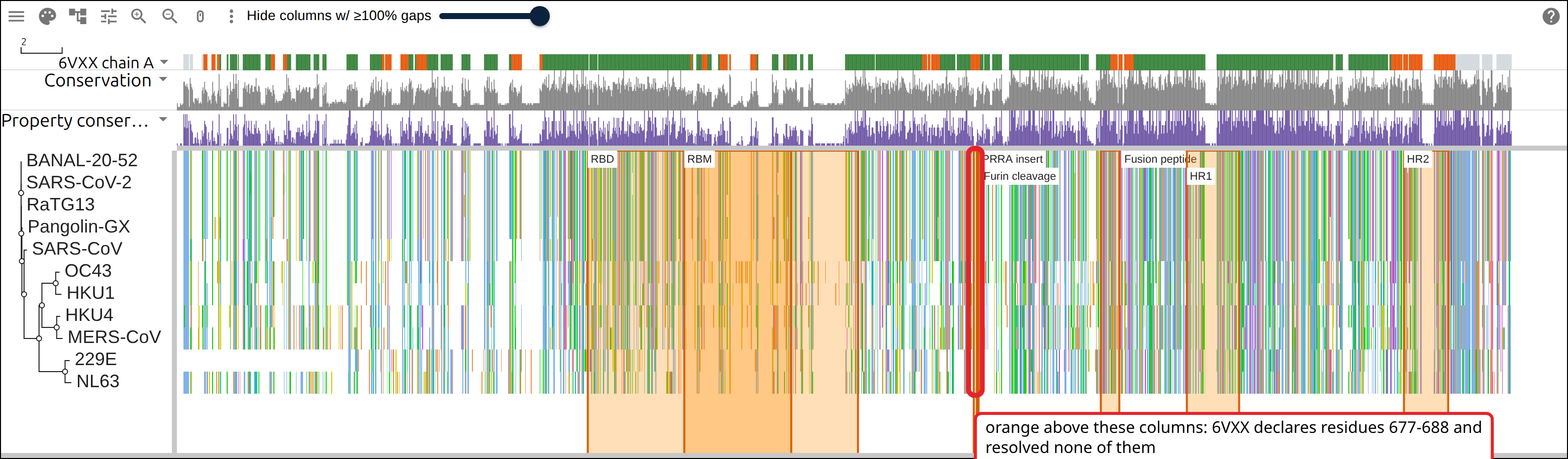
6VXX declares residues 696 to 707, row residues 677 to 688, and resolves none of them. The insert sits in the middle of that stretch: 0 of its 4 residues are observed, and 0 of the 2 in the cleavage site beside it.
8. A fully resolved region#
The control is the same row, chain and layer at the first heptad repeat:
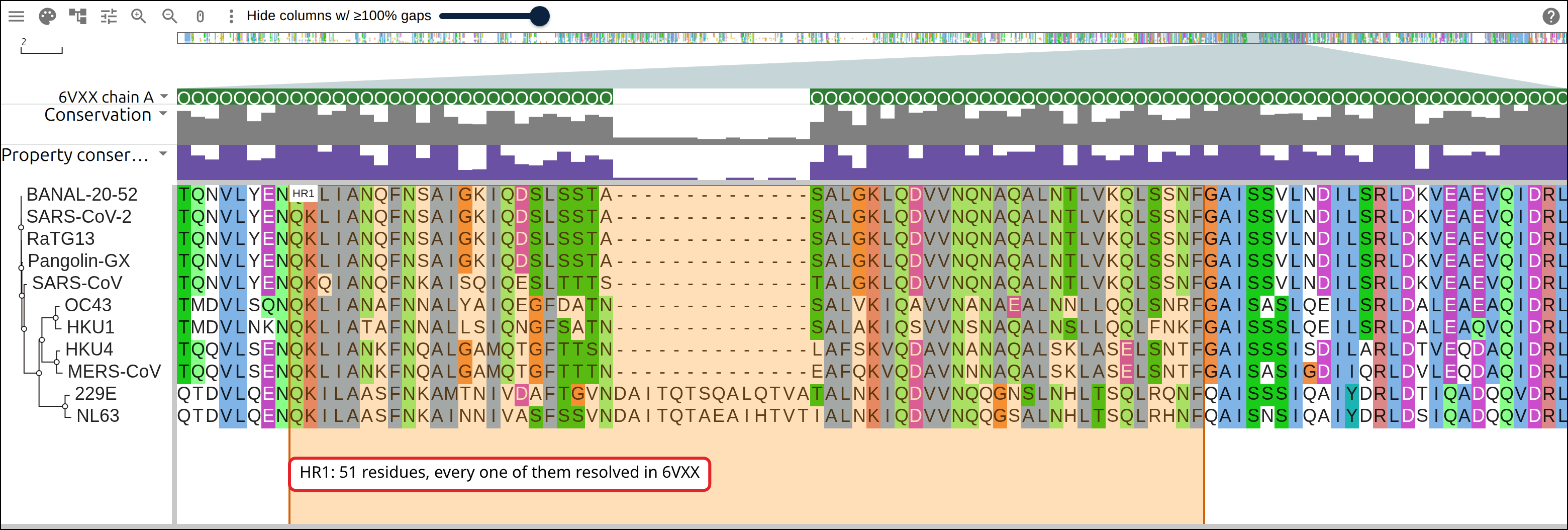
Coverage across the regions UniProt annotates on this row:
| Region | Observed | Declared, not resolved |
|---|---|---|
| RBD (319-541) | 193 | 30 |
| RBM (437-508) | 42 | 30 |
| PRRA insert (681-684) | 0 | 4 |
| Furin cleavage (685-686) | 0 | 2 |
| Fusion peptide (816-837) | 12 | 10 |
| HR1 (920-970) | 51 | 0 |
| HR2 (1163-1202) | 0 | 40 |
The receptor-binding motif is the tip that swings up to meet ACE2, and 30 of its 72 residues are unresolved in this closed trimer. HR2 sits past residue 1147, where the model stops.
9. Check it against the raw data#
Three commands recover the key numbers from the source data:
# the insert, in the row the viewer draws
awk '/^>SARS-CoV-2/{getline; print index($0, "PRRA")}' spike.fasta

# the block the mapping's one segment came from
curl -s https://www.ebi.ac.uk/pdbe/api/mappings/uniprot/6vxx |
  jq -c '.["6vxx"].UniProt.P0DTC2.mappings[] | select(.chain_id == "A") |
         [.unp_start, .unp_end, .start.residue_number, .end.residue_number]'

# the stretch the furin loop falls in, in label_seq_id
curl -s https://www.ebi.ac.uk/pdbe/api/pdb/entry/polymer_coverage/6vxx/chain/A |
  jq -c '.["6vxx"].molecules[0].chains[0].observed[9,10] |
         [.start.residue_number, .end.residue_number]'
681
[14,1211,33,1230]
[660,695]
[708,846]The highlight starts at 681. [14,1211,33,1230] is the segment in the layer,
offset 19. The observed stretches on either side end at 695 and resume at 708,
so 696 to 707 have no coordinates. Those are row residues 677 to 688, the loop
that holds the insert.
10. Open the whole thing#
The view combines three hosted files and three layers. The files go behind URLs, because an alignment does not fit in a link, and the layers go in the link, because they take a few kilobytes:
{
  "msaview": {
    "type": "MsaView",
    "colWidth": 0.8,
    "rowHeight": 22,
    "colorSchemeName": "clustalx_protein_dynamic",
    "msaFilehandle": { "uri": "https://example.org/spike.afa" },
    "treeFilehandle": { "uri": "https://example.org/spike.nwk" },
    "gffFilehandle": { "uri": "https://example.org/spike-domains.gff" }
  }
}
Add the columnTracks, highlights and residueMappings entries from the
sections above beside those three, URL-encode the whole object, and hang it off
the app as #data=.
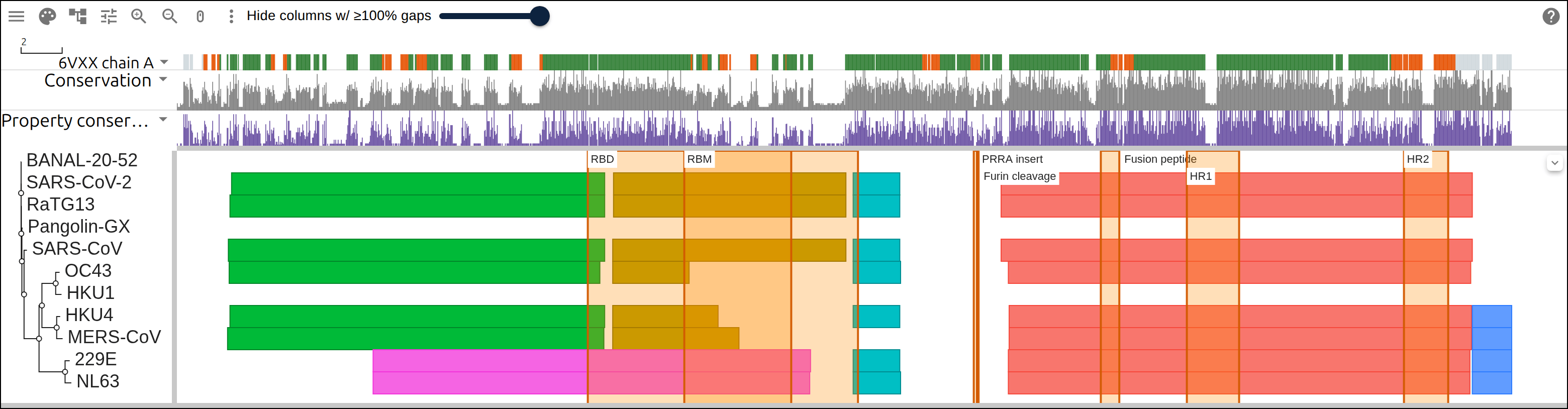
A host that loads this view can look up a row residue in the structure, and gets
undefined where the mapping has no answer:
model.structureResidue('SARS-CoV-2', 970) // 6VXX 989, observed
model.structureResidue('SARS-CoV-2', 681) // 6VXX 700, not observed
model.structureResidue('SARS-CoV-2', 1250) // undefined: past the construct
model.structureResidue('RaTG13', 681) // undefined: no mapping for that row
model.rowResidue('6VXX', 700) // SARS-CoV-2, residue 681
Reproduce it end to end#
curl -O https://raw.githubusercontent.com/GMOD/JBrowseMSA/main/docs/tutorials/scripts/build_spike_structure.sh
bash build_spike_structure.sh
With no arguments the script writes the row table above and builds all four files beside it, printing every number on this page. Pass your own table to do the same for another family and another structure:
bash build_spike_structure.sh my-rows.tsv out/See also#
- Data layers
- An alignment linked to its structure
- A protein family from a list of accessions
- CLI
- User guide
References#
- Walls AC, Park YJ, Tortorici MA, Wall A, McGuire AT, Veesler D. Structure, Function, and Antigenicity of the SARS-CoV-2 Spike Glycoprotein. Cell 181:281-292.
- Zhou P, Yang XL, Wang XG, et al. A pneumonia outbreak associated with a new coronavirus of probable bat origin. Nature 579:270-273.
- Temmam S, Vongphayloth K, Baquero E, et al. Bat coronaviruses related to SARS-CoV-2 and infectious for human cells. Nature 604:330-336.
- Lam TT, Jia N, Zhang YW, et al. Identifying SARS-CoV-2-related coronaviruses in Malayan pangolins. Nature 583:282-285.
- Dana JM, Gutmanas A, Tyagi N, et al. SIFTS: updated Structure Integration with Function, Taxonomy and Sequences resource allows 40-fold increase in coverage of structure-based annotations for proteins. Nucleic Acids Research 47:D482-D489.
- Katoh K, Standley DM. MAFFT multiple sequence alignment software version 7. Molecular Biology and Evolution 30:772-780.
- Price MN, Dehal PS, Arkin AP. FastTree 2: approximately maximum-likelihood trees for large alignments. PLoS ONE 5:e9490.
- Blum M, et al. InterPro: the protein sequence classification resource in 2025. Nucleic Acids Research 53:D444-D456.
- Bateman A, et al. UniProt: the Universal Protein Knowledgebase in 2025. Nucleic Acids Research 53:D609-D617.